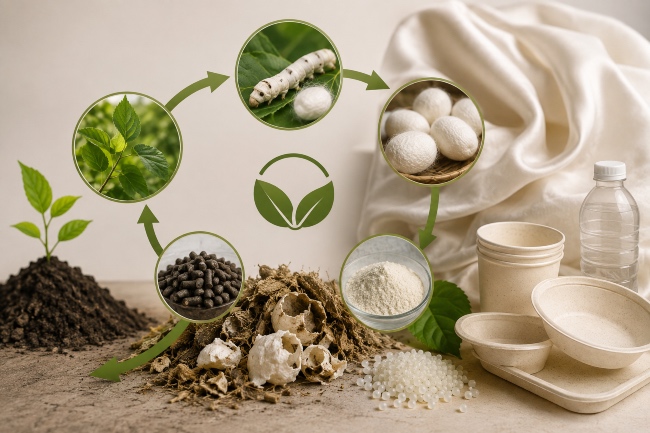
Sericulture is organised around a single noble product, the continuous filament that unwinds from the cocoon, and it tends to consign everything else to the undifferentiated category of waste. Anyone familiar with silk knows how misleading that category is, because the very fibroin destined to become thread coexists with a mass of sericin, pupae, unreelable cocoons and plant biomass which, read with different eyes, turn out to be streams rich in structured proteins, polysaccharides and lipids. It is on these streams that the possibility now rests of turning the silk supply chain from a linear sequence into a circular system, one in which every fraction finds a valuable destination and bioplastics become the natural outcome of a material that nature has already, in large part, organised.
The hidden waste along the silk supply chain
To grasp the scale of the phenomenon it helps to consider the weight proportions of the cocoon. The silk portion, the part that becomes thread, represents only a minority of the fresh cocoon mass, while the pupa inside makes up the dominant share. Within the shell, moreover, fibroin is accompanied by a fraction of sericin that usually ranges between a fifth and a third of the weight of the raw silk, a protein glue that must be removed for the filament to reveal its lustre. It follows that every kilogram of processed silk drags along several kilograms of pupae and a far from marginal quantity of sericin dissolved in the processing baths. To these two items are added the cocoons pierced by the moths in the lots reserved for reproduction, the outer floss, the reeling waste and, upstream of the entire process, the mulberry biomass that feeds the silkworms. Taken together, these fractions far exceed the main product in mass, which makes their valorisation not an accessory detail but the very pivot of any hypothesis about the sustainability of the chain.
Sericin recovered from the degumming baths
Sericin is the protein that most directly connects silk to the world of bioplastics, because it is already extracted by the production process and too often ends up dissolved in wastewater with an extremely high organic load. During degumming, carried out in an alkaline environment or at high temperature and pressure, sericin hydrolyses and passes into solution, leaving the fibroin clean but loading the effluent with a chemical oxygen demand that represents a serious environmental problem in silk districts. Recovering it means solving a treatment criticality and opening access to a valuable protein raw material at the same time. Recovery techniques run through membrane ultrafiltration of the spent baths, precipitation with ethanol, thermal concentration and spray drying or freeze drying, with one not insignificant detail tied to molecular weight. Aggressive degumming conditions fragment the protein chain and produce low molecular weight sericin, less suited to forming cohesive films, whereas milder treatments preserve its integrity and return a material with better film-forming properties. The sericin obtained in this way is markedly hydrophilic and rich in serine, shows antioxidant capacity and absorption in the ultraviolet and retains moisture, features that make it attractive for active coatings, edible films and protective layers. On its own it tends towards brittleness, so it finds its best expression when plasticised with glycerol or sorbitol or blended with other polymers that offset its rigidity.
Regenerated fibroin and protein-based films
Alongside sericin, fibroin coming from waste can also abandon the form of thread to take on that of a plastic material. Pierced cocoons, floss and reeling waste are not reelable, yet they remain fibroin in every respect and can be regenerated in solution. The classic route involves dissolving the degummed silk in highly concentrated lithium bromide or in the ternary reagent based on calcium chloride, ethanol and water, followed by dialysis to obtain an aqueous solution of regenerated fibroin ready for shaping. From that solution transparent films are cast, foams are produced and coatings are made, and the true technological lever lies in the control of crystallinity. Fibroin alternates amorphous domains with crystalline beta-sheet domains, and the proportion of the latter governs the water resistance and mechanical properties of the article. Treatments with methanol, annealing in water vapour or the application of mechanical stresses induce the transition towards the beta sheet, turning a soluble and yielding film into an insoluble and tough structure. By regulating this transition one moves from water-soluble materials, useful for release applications, to stable materials suited to durable uses. The introduction of plasticisers, once again glycerol in the front row, makes it possible to overcome the intrinsic brittleness and even opens the way to a thermoplastic fibroin, mouldable with techniques closer to those of conventional plastics than to textile ones.
Pupae as a mine of chitin, protein and lipids
If sericin and fibroin represent the most direct protein route, the pupae constitute the most abundant and perhaps most underestimated deposit of the entire chain. The silkworm pupa is composed of roughly half protein and a significant share of lipids, and it retains in its cuticle and exuviae a fraction of chitin. This composition lends itself to a cascade extraction logic that dismantles the waste into several value streams. Pupal oil, obtainable by pressing or solvent extraction, can feed the production of biodiesel or supply building blocks for plasticisers of biological origin. The residual protein fraction lends itself to hydrolysis and to conversion into films or into matrices for feed uses. The chitin-rich material is finally demineralised, deproteinised and deacetylated to give chitosan, the cationic polysaccharide that opens the way to a family of bioplastics with very interesting properties. In this way a wet and easily putrescible biomass, for a long time destined for low-value feed or disposal, breaks down in an orderly fashion into oil, protein and polysaccharide, each with its own processing chain.
Chitosan and antimicrobial composite films
Chitosan derived from the pupae deserves particular attention because it naturally completes the palette of silk biopolymers. It is a film-forming, biodegradable polysaccharide endowed with intrinsic antimicrobial activity, qualities that make it an ideal candidate for active food packaging. Its cationic nature converses well with the acidic character of sericin, and blending the two gives rise to polyelectrolyte complexes in which the mechanical shortcomings of the protein are compensated by the structure of the polysaccharide. The result is films with better strength, lower water sensitivity and the ability to slow microbial growth on the surface of foods, a performance profile that makes it possible to imagine wraps and coatings capable of prolonging preservation without resorting to fossil materials. The convergence of fibroin, sericin and chitosan, all obtainable from the same chain, allows the design of blends and multilayer systems calibrated to the application, where each component brings the property that belongs to it and the overall result exceeds what any single biopolymer would achieve on its own.
Mulberry beyond the leaf and the closing of the agronomic loop
The circularity of sericulture does not end at the cocoon, because upstream there is the mulberry and downstream there are the silkworm droppings. Mulberry pruning generates a substantial lignocellulosic biomass, rich in cellulose and therefore convertible into nanocelluloses, in the form of nanocrystals or nanofibrils, which represent an excellent reinforcement for protein matrices. Introducing nanocellulose into a film of fibroin or sericin means increasing its stiffness, improving its barrier properties and reducing its sensitivity to humidity, obtaining fully biobased composites in which the plant component and the protein component come from the same productive sphere. Mulberry biomass also carries polyphenols and bioactive compounds that can be valorised separately. The silkworm droppings, for their part, lend themselves to anaerobic digestion for biogas production and to conversion into an organic soil amendment, returning to the mulberry orchard a portion of the organic matter and closing the loop exactly where the cycle had begun.
A valorisation cascade along the silk district
Lined up together, these streams sketch a genuine silk biorefinery, in which the guiding principle is cascade valorisation according to the decreasing value of the destinations. The most prized protein fractions of sericin and fibroin find their most profitable use in the cosmetic and biomedical fields, where the functional properties of silk prove hard to replace. What exceeds these applications feeds the production of bioplastics for packaging and for agricultural mulching, films designed to perform their function and then biodegrade in a controlled way in the soil or in composting plants, avoiding the persistence typical of fossil polymers. The less noble fractions, finally, converge towards energy production and agronomic return. A scheme of this kind finds its most efficient expression on a territorial scale, where the proximity between mulberry orchards, farms, reeling mills and processing plants reduces logistical costs and makes it possible to treat wet and perishable flows such as the pupae before they degrade. The silk chain, historically rooted in well-defined districts, possesses precisely that local dimension which makes the integration between the different rivulets of matter workable, turning an ancient production model into a concrete laboratory of biopolymer circular economy.
