
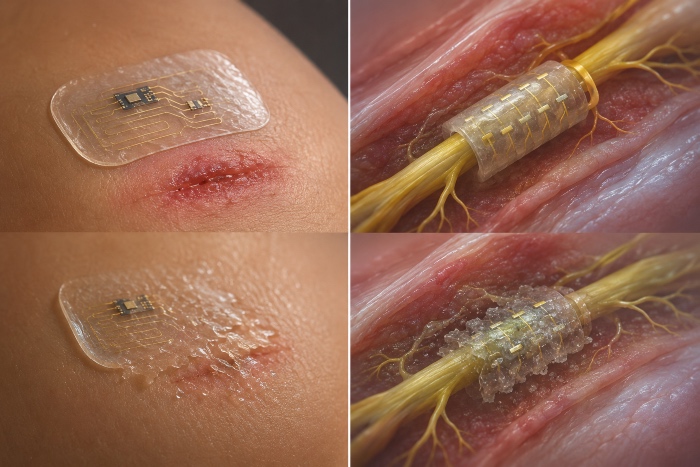
A sensor as thin as a plaster, resting on the skin for a few days to record the temperature of a healing wound, and then able to dissolve on its own without leaving a trace. A tiny device implanted beside an injured nerve that delivers electrical stimulation for two weeks and, once its task is done, is reabsorbed by the body with no need for a second operation to remove it. This is not a science-fiction scenario, but the heart of a line of research that over the past fifteen years has turned an ancient protein, silk fibroin, into one of the most promising materials for a new generation of electronics.
The idea behind these devices overturns one of the most deeply rooted assumptions of electronic engineering. For decades we have designed circuits to last as long as possible, resistant to water, heat and wear. Transient electronics reverses this logic and treats disappearance not as a failure but as a function. The device is born with an expiry date written into its very structure, works for exactly as long as it is needed, and then dissolves in a governed way, reabsorbed by biological tissue or dispersed without harm into the environment. It is a subtle yet profound shift in paradigm, because it moves the focus from durability to programmed impermanence, and opens the door to uses that would be unthinkable with conventional electronics.
Fibroin as the stage
The silk produced by the Bombyx mori silkworm is made up of two main proteins, fibroin, which forms its structural core, and sericin, which wraps around it like a natural glue. By removing the sericin through a process known as degumming, one obtains an extremely pure fibroin that can be brought back into aqueous solution and then reworked into thin films, membranes, sponges or nanofibres. It is precisely this processing versatility, carried out entirely in water and at mild temperatures, that makes fibroin so different from the synthetic polymers that dominate traditional electronics.
The reasons this protein has established itself as a material of choice are several and mutually reinforcing. Fibroin is biocompatible and, as it degrades, generates by-products of very low immunogenicity that are tolerated by tissue without triggering significant inflammatory reactions. It is transparent to light, mechanically robust while remaining flexible, and can be sterilised without losing its properties. Yet its truly decisive feature is another, and it concerns time. The rate at which fibroin dissolves in water is not a fixed quantity but a parameter that can be tuned with precision at the manufacturing stage.
Time becomes a design parameter
The secret of controlled dissolution lies in the protein's molecular architecture. Fibroin can organise itself into ordered crystalline domains, the so-called β-sheets, or into more disordered amorphous regions. The higher the fraction of β-sheets, the more the material resists water and the slower its degradation becomes. Researchers have learned to modulate this balance through treatments such as water-vapour annealing or exposure to methanol, obtaining films that dissolve within minutes on contact with water or, at the opposite extreme, remain stable for days or weeks before giving way.
This ability to write a lifespan into the material has very concrete implications. A device intended for extremely brief use, such as a tag that must self-destruct to protect a piece of information, can be built from poorly crystalline fibroin that vanishes almost instantly in water. An implant that must accompany the healing of a tissue for two or three weeks calls instead for a more crystalline formulation, perhaps shielded by additional encapsulation. One of the most elegant strategies, developed by the pioneering groups at Tufts University, consists of enclosing the fragile components in multilayer fibroin pockets that act as a barrier against water penetration, extending the device's useful life in a predictable way. By modulating thickness, number of layers and degree of crystallinity, disappearance ceases to be a random event and becomes a design specification.
From the skin to the brain
The story of this technology begins some way back. As early as the late 2000s, the laboratories led by John Rogers, Fiorenzo Omenetto and David Kaplan showed that silicon circuits could be built on silk substrates as a route towards implantable, resorbable devices. In 2012 came the proof that silicon itself, reduced to ultrathin membranes, could dissolve within the body at a rate of a few nanometres per day, opening up the notion of a fully transient electronics in which not only the support but also the active part eventually disappears. Two years later, a resorbable silk-based device was used to deliver heat in a controlled manner and combat a bacterial infection in vivo, before being completely reabsorbed. In 2016 a fully dissolvable silicon sensor was implanted to monitor pressure and temperature inside the brain, with performance comparable to that of non-resorbable clinical standards, but without the need for a removal procedure.
From those first demonstrations the field has branched into two broad directions. On the skin, fibroin serves as the basis for an epidermal electronics able to adhere conformally and record physiological signals such as cardiac and muscular activity or sweat-related parameters, and then simply be washed away at the end of its use. Inside the body, the same principles drive temporary intracranial pressure sensors, neural interfaces that accompany nerve regeneration, temporary cardiac pacemakers free of batteries and permanent leads, and platforms for the targeted release of drugs that dose the active ingredient exactly where it is needed and then dissolve, sparing the patient the risk and the burden of an implant that stays behind. In all these cases, programmed disappearance eliminates at the root the problem of extraction, which in conventional implantable electronics represents a far from negligible surgical risk.
The most recent frontiers
Over the past two years research has pushed on three fronts that are making these devices more capable and closer to real-world use. The first concerns mechanics. Pure fibroin tends to be stiff and lacking in toughness, matching poorly with the softness of skin, and to overcome this limitation modified formulations have been developed, for instance with the addition of calcium, that make the films soft, elastic and able to follow the body's folds without peeling away. The second front targets energy autonomy, with piezoelectric nanofibres obtained by electrospinning a combination of fibroin, polyvinyl alcohol and carbon quantum dots, capable of generating current from simple movement and of working as self-powered wearable sensors that are water-soluble at end of life. The third concerns adhesion and the duration of contact, with self-adhesive silk bioelectronics designed for prolonged electrophysiological monitoring, and with the clever use of sericin, the often-discarded protein, as an adhesive layer that keeps the device firmly attached to the skin.
Alongside these advances comes a flowering of scientific reviews published between 2025 and 2026 that take stock of the state of the art, a sign that the field is moving beyond the purely exploratory phase to grapple with the questions of scaling up engineering and of clinical translation. Silk is by now described no longer as a laboratory curiosity, but as a sustainable platform for flexible, wearable and biodegradable electronics.
