
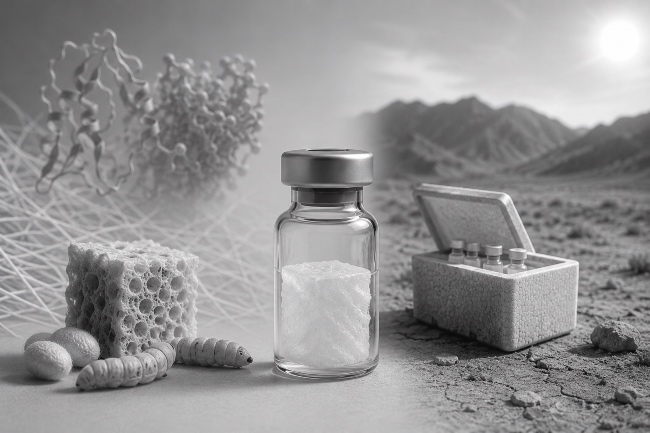
The cold chain represents one of the most costly and fragile constraints in the entire global immunization system. Most vaccines require continuous storage between two and eight degrees Celsius, and in some cases even at ultra-low temperatures, and any interruption of this thermal supply line can compromise the efficacy of the preparation, rendering it unusable. It is estimated that a significant portion of the doses produced worldwide is wasted precisely because of thermal deviations during transport and storage, a problem that weighs disproportionately on resource-limited settings, where the availability of reliable refrigeration and continuous electrical power is far from guaranteed. It is against this backdrop that research on biopolymeric materials has begun to explore solutions capable of stabilizing antigens outside of refrigeration, and silk fibroin has emerged as one of the most promising candidates.
Why fibroin works as a stabilizer
Fibroin is the structural protein that makes up the core of the filament produced by the silkworm Bombyx mori. Its distinctive feature lies in its molecular architecture, dominated by hydrophobic domains rich in glycine, alanine and serine that organize themselves into highly crystalline beta-sheet structures. These regions confer on the material a remarkable mechanical and thermal stability, while the amorphous portions ensure flexibility and the capacity to interact with other molecules. When an antigen, whether a protein, an attenuated virus or another immunogen, is incorporated into a fibroin matrix, the silk protein acts as a protective scaffold that immobilizes the target molecule and limits the conformational movements responsible for degradation.
The stabilization mechanism rests on several concurrent phenomena. Fibroin is capable of forming multiple hydrogen bonds with the encapsulated molecules, effectively substituting the role that water plays in maintaining the native conformation of proteins, a principle known in pharmaceutical science as the water replacement theory. At the same time, the matrix reduces molecular mobility within the system, creating a high-viscosity glassy environment in which the reactions of denaturation, aggregation and hydrolysis are drastically slowed. This molecular "caging" effect preserves the three-dimensional structure of the epitopes, that is, precisely those antigenic regions that the immune system must recognize in order to generate an effective protective response.
The physical forms of the protective matrix
One of the most interesting aspects of fibroin is its formulation versatility. The biopolymer can be processed under entirely aqueous conditions, without recourse to aggressive organic solvents that would risk damaging the antigens during processing. Starting from solutions of regenerated fibroin, it is possible to obtain thin films, microspheres, hydrogels, freeze-dried sponges and even three-dimensionally printed structures, each with distinct release and protection characteristics.
Fibroin films represent perhaps the most studied configuration for thermostabilization. By depositing a solution containing the antigen and allowing it to dry under controlled conditions, one obtains a film in which the immunogen is uniformly dispersed and sealed. The subsequent induction of beta-sheet crystallization, which can be achieved through treatment with water vapor or exposure to specific alcohols, further increases the thermal resistance of the material and regulates its rate of dissolution. Now-classic studies in this line of research have demonstrated the preservation of vaccines and other biologics, including the MMR vaccine against measles, mumps and rubella, retaining a significant fraction of the original activity after prolonged exposure to elevated temperatures that would otherwise have destroyed conventional preparations.
The advantage under high and prolonged temperatures
The real value of this technology emerges under conditions of thermal stress. Several studies have documented the capacity of the fibroin matrix to preserve the integrity of antigens and biologics even after weeks or months of storage at temperatures on the order of forty or sixty degrees Celsius, a range that in many tropical regions corresponds to the actual environmental conditions during transport. The possibility of eliminating, or at least significantly loosening, the dependence on refrigeration would transform the logistics of immunization, reducing waste, cutting the infrastructural costs tied to refrigerators and generators, and bringing vaccines to remote areas that have so far been difficult to reach.
Added to this is a particularly favorable biocompatibility profile. Fibroin is approved for numerous biomedical applications, is degraded by the body into non-toxic amino acids and presents a negligible inflammatory response, characteristics that make it suitable not only for storage but also for formulations intended for direct administration, including the prospects of dissolving microneedles in which the silk serves both as a stabilization matrix and as a vehicle for transdermal release.
