
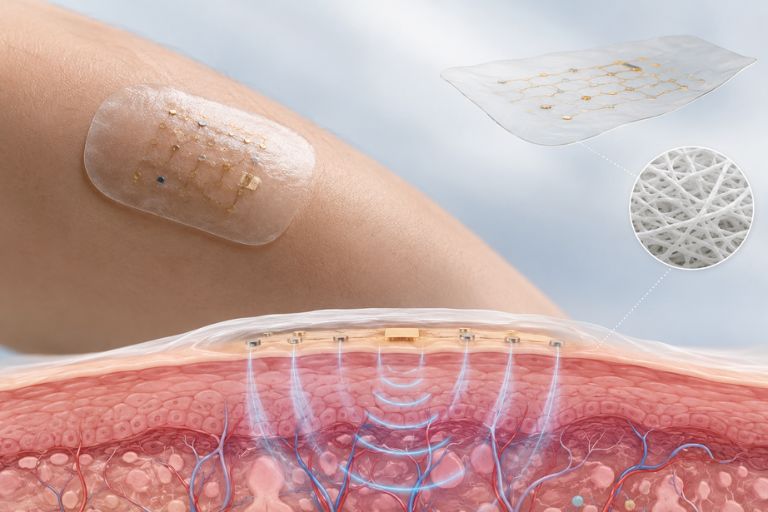
There is a certain irony in the fact that one of the most promising materials for next-generation wearable electronics is also one of the oldest that humanity has ever learned to work with. Bombyx mori silk has clothed emperors and crossed continents long before the word "biosensor" even existed, and today that same filamentous protein — appropriately dissolved, regenerated, and recrystallized — is being called upon to do something its textile history never foreshadowed: adhere to skin without irritation, conduct electrophysiological signals, host molecular transduction systems, and, once its task is complete, dissolve without leaving a trace. The silk fibroin patch is precisely this point of convergence, and it is a far more interesting object than its apparent simplicity suggests.
Skin as a diagnostic interface
To understand why so much effort is being invested in a smart patch, it is worth starting with the biological substrate on which it rests. The skin is not merely a barrier: it is an information-rich surface, crossed by electrical signals, traversed by fluids carrying metabolites, and sufficiently accessible to be interrogated continuously without sampling or needles. Sweat, in particular, contains a real-time chemical snapshot of the body's metabolic, hormonal, and hydroelectrolytic state — from glucose to lactate to cortisol. Historically, the problem has never been what to measure, but rather what to measure it with: the interface between a rigid device and living tissue — soft, deformable, and constantly in motion — is where most wearable systems lose reliability. This is where the choice of structural material ceases to be an engineering detail and becomes the central issue.
Why fibroin: a protein that behaves like a programmable material
Fibroin is the structural component of silk, and its chemistry explains much of its virtue. Its primary structure is dominated by a repeated amino acid sequence, built around recurring units of the glycine–serine–glycine–alanine–glycine–alanine type, which organize into densely packed antiparallel β-sheets. This architecture generates highly stable crystalline regions alternating with softer amorphous domains, and from this internal contrast arise both the mechanical robustness and the flexibility that make the material so suitable for tissue contact.
Fibroin can assume three conformations known as silk I, silk II, and silk III. Silk I is the amorphous, water-soluble form, as secreted by the silkworm's glands; silk II is the crystalline arrangement of β-sheets typical of spun fiber, and it is what gives silk its strength; silk III forms primarily at interfaces, such as the air-water interface. The crucial point is that the transition from one form to another is not capricious but controllable by processing, and this transforms fibroin into something more akin to a programmable material than a passive polymer. To these conformational properties are added characteristics that the literature frequently lists with notable consistency: tunable water solubility, remarkable optical transparency, lightness, good mechanical robustness, and ease of processing that few natural biopolymers can boast — all combined with intrinsic biocompatibility and biodegradability.
From silkworm cocoon to film: the processing pathway
It all begins with an operation that has textile roots and an almost domestic name: degumming. Bombyx mori cocoons are boiled in an aqueous sodium carbonate solution to remove sericin, the water-soluble glycoprotein that, within the cocoon, glues the fibroin filaments together but which, if left in place, can trigger unwanted immune responses. Once the sericin is removed, the fibroin is dissolved — typically in a lithium bromide solution at around sixty degrees Celsius — to obtain regenerated fibroin in aqueous solution, the versatile raw material from which almost everything else takes shape.
From that solution, different geometries can be obtained depending on the application: thin, optically transparent films; soft, water-rich hydrogels; nanofiber mats produced by electrospinning. Each of these forms starts from the same material but exhibits very different behaviors, and the difference is almost entirely played out in the degree of crystallinity. Films, hydrogels, and electrospun mats with low crystallinity and high specific surface area degrade rapidly; increasing the β-sheet content dramatically slows the process. And it is precisely this lever that the designer learns to manipulate.
Crystallinity control as a design lever
The way in which crystallization into silk II is induced is the keystone of the entire approach. Treatments with methanol, thermal annealing, crosslinking processes, or controlled vapor exposures induce the formation of β-sheets and, in doing so, allow the tuning of degradation time from a few days up to several weeks. Experimental evidence gives a measure of how wide this window is: under simulated physiological conditions, highly crystalline fibroin shows limited degradation — on the order of one-fifth of its mass over several months in buffer solution — while less crystalline forms disappear much faster.
This property is not merely a matter of durability. In the most sophisticated uses, crystallinity becomes a fully functional parameter: since the β-sheet content governs the film's erosion rate, the same mechanism can be exploited to regulate, for example, the release kinetics of a drug incorporated into the silk matrix, all the way to integrating wirelessly powered bioabsorbable microheaters to accelerate diffusion. The patch, in other words, does not merely listen; it can also respond, and the margin within which it does so is written into its very degree of molecular order.
The skin-device interface: adhesion, conformability, comfort
However refined the substrate's chemistry may be, a patch that does not adhere well is useless. The adhesion between a flexible sensor and the skin surface is the condition that determines whether the collected signals will be accurate, reproducible, and stable over time — or merely noise. Here, recent research has produced remarkable results precisely by exploiting fibroin as an adhesive, not merely as an inert support. Microstructured fibroin-based protein adhesives have been developed that achieve highly conformable and tunable contact, maintaining reliable bonding strength even under humid or fully wet conditions — the scenario, it must be said, in which any epidermal patch is destined to operate — and which can be removed without significant pain. The advantage is not cosmetic: by improving adhesion and conformability, these adhesives enhance the sensitivity and reusability of the deformation sensors coupled with them.
On the mechanical performance front, the most recent developments have raised the bar further. Calcium-modified fibroin ionogels, in which metal chelation and water retention mechanisms are exploited together, achieve elongations of up to over seven hundred percent and adhesion measured at around twenty-five kilopascals on porcine skin, ensuring a stable electrode-skin interface for real-time physiological monitoring. Numbers that, translated from the data sheet to everyday life, mean a device that follows the skin as it stretches, bends, and flexes without detaching and without losing electrical contact.
Epidermal electrodes and biopotential signals
The first family of applications is where the patch acts as an electrode. For decades, the standard in electrocardiography has been the silver/silver chloride gel electrode — reliable but rigid, prone to drying out, and not very forgiving to the skin in prolonged applications. Fibroin has opened an alternative, and in some cases competitive, path: silk hydrogel-based epidermal electrodes combine excellent conformability and biocompatibility, and when nanomaterials or conductive polymers are incorporated, they yield skin interfaces that, in experimental demonstrations, match or exceed the performance of conventional electrodes in detecting cardiac signals.
The repertoire does not stop at ECG. Incorporating tungsten microparticles into a fibroin solution yields conductive silk composites that act simultaneously as electrode and as sensitive material, integrated with fibroin films and sericin-based adhesives enhanced with ions to improve grip; systems of this type detect mechanical deformations, capacitive touches, and electrophysiological signals up to electroencephalography. In a related direction, smart wristbands combining molybdenum and gold filamentary mesh microelectrodes with mesoscopically hybridized fibroin films read biopotential signals such as electrocardiogram and electromyography, even translating muscle activity into gesture commands interpreted by algorithms. This is the point at which monitoring crosses over into human-machine interaction, and silk finds itself, despite itself, acting as a bridge.
Continuous biosensing: reading sweat in real time
The second major family of applications is also the most ambitious, because it aims to measure not just the electrical signal but the body's chemistry. Sweat is the privileged target fluid, for obvious reasons of non-invasive accessibility, but it brings with it a troublesome practical problem: it is secreted slowly — on the order of one microliter per minute per square centimeter during exercise, and about half that under thermal stimulation — and evaporates quickly, making it difficult to collect a fresh, abundant sample not contaminated by residues from previous secretion. The answer to this knot is microfluidics: tiny channels that convey freshly produced sweat by capillarity toward the detection region, reducing evaporation and separating the new sample from the old. Unsurprisingly, fibroin — already naturally accustomed to directional fluid transport — lends itself well to this structural role as well.
On this basis, continuous biosensors have been demonstrated for an ever-widening range of markers. Epidermal patches with biomimetic microfluidic channels monitor glucose and lactate in sweat over time; lactate-dedicated platforms, equipped with a microchannel, cover physiologically useful concentration ranges and show a correlation between sweat lactate and blood lactate, valuable for medicine and sports; prolonged glycemic monitoring systems collect sweat over extended time windows to track glucose fluctuations, including hypoglycemic events. Fibroin enters these architectures both as a soft, breathable, biocompatible substrate capable of intimate skin contact without irritation and, in more advanced systems, as an active support for the transducer.
Transduction mechanisms: from molecule to data
Measuring a molecule means converting it into a readable signal, and here different technological families coexist, each with its own logic. The electrochemical approach, the most classic, exploits enzymes or antibodies as recognition elements and translates the reaction into current or potential; it is sensitive and mature, but suffers from the fragility of biological elements, vulnerable to environmental interference and decay over time. The piezoresistive approach, for its part, is that of deformation sensors: fibroin composites structured with ingenious techniques — rose petal templating combined with hollow carbon nanospheres is an elegant example — achieve high sensitivity, response times on the order of a few hundred milliseconds, and durability over tens of thousands of cycles, making them suitable for reading joint flexions, muscle activities, and facial expressions.
Perhaps the most fascinating frontier, however, is the optical and plasmonic one. Biosensors based on surface-enhanced Raman scattering (SERS), built on the fibroin substrate with ordered metallic nanostructures — binary nanosphere arrays, bimetallic inverse opal structures — generate "hot spots" capable of enormously enhancing the Raman signal and returning a true chemical fingerprint of the target molecule without the need for labeling. On this logic, patches have been demonstrated that simultaneously detect creatinine and uric acid, systems for cortisol alongside pH as a marker of psychophysiological stress — with aptameric probes designed for specific recognition — and chrono-epifluidic nanoplasmonic patches for label-free profiling of sweat metabolites. Finally, the raw data must exit the skin: the most integrated systems couple the sensing patch with a flexible printed circuit board for signal processing and wireless transmission, closing the loop between molecule and screen.
Transient electronics and the environmental question
There is one final property of fibroin that, in an era attentive to electronic waste, is worth at least as much as its performance: its ability to disappear. Transient, or bioresorbable, electronics arise precisely from the idea of devices designed to dissolve safely in the biological environment once their function is complete, avoiding removal procedures and, in the case of wearables, reducing the e-waste burden. Fibroin is one of the materials of choice for this paradigm, and the reason is once again controllable crystallinity: the same parameter that determines mechanical durability also determines the dissolution rate, allowing the design of a device that remains stable for the necessary time and then withdraws. It is the same protein that, in its textile version, lasted for centuries; in its electronic version, it can be instructed to last for days. Few materials offer this dual personality so naturally.
From prototype to clinic: validation and regulatory hurdles
It would be dishonest to conclude without noting the distance that separates a laboratory demonstration from a usable medical device. The open challenges are concrete. The correlation between the concentrations of a biomarker in sweat and those in blood is not always linear nor constant across individuals, which requires robust calibrations and compensation strategies, for example with respect to pH or sweating rate. The long-term stability of biological recognition elements remains a critical point, and it is one of the reasons for the growing interest in non-enzymatic and label-free approaches. Reproducibility between batches of regenerated fibroin — a natural material and therefore intrinsically variable — must be demonstrated with reliable process standards. And then there is the equally demanding terrain of clinical validation and the regulatory pathway: demonstrating accuracy, safety, and reliability with the rigor required of a device intended to inform health decisions is a long task, consisting of performance substantiation and evidence, which runs on different tracks from publishing a brilliant result in a journal.
Perspectives
The silk fibroin patch tells a broader story well: the encounter between ancient biological materials and advanced microelectronics is reshaping the very idea of monitoring, moving it from episodic sampling to continuous reading, from the device you wear to the device you forget you are wearing, and ultimately to the device that, once its task is complete, simply is no longer there. Silk arrives at this appointment with credentials that few synthetic materials can match — biocompatibility, tunable degradability, processability — and with the not inconsiderable advantage of a production chain consolidated over millennia. The validation numbers remain to be consolidated and the regulatory path to be traveled, but the direction is clear: the biosensor of the near future will look less and less like an instrument and more and more like a second skin, and it will most likely be made of protein.
