
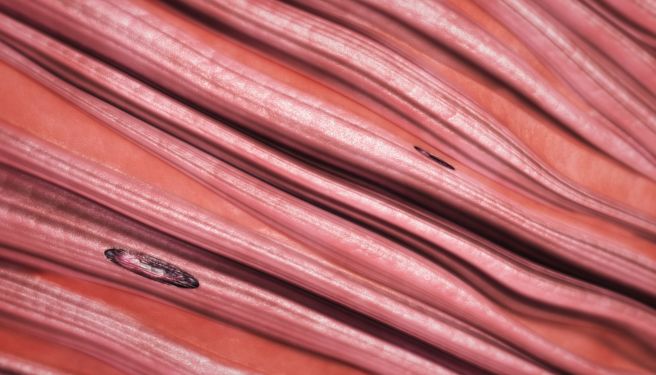
A tendon is an anisotropic biological material, poorly vascularized, sparsely cellular, and shaped by evolution to transmit tensile loads on the order of tens of megapascals with minimal energy loss. When injured, the spontaneous repair process almost always leads to disorganized scar tissue rich in type III collagen and mechanically inferior to native tissue. It is in this context that fibroin-based matrices have gained attention, because they offer a combination that is difficult to replicate with other biopolymers: high tensile strength, tunable proteolytic degradation, and a surface chemistry versatile enough to support tenogenic differentiation.
Why fibroin competes with collagen in high-load tendon applications
The central challenge of tendon scaffolds is not so much biocompatibility as initial mechanical competence. A matrix that collapses during the first weeks after implantation, before cells have deposited their own extracellular matrix, is useless regardless of its biological profile. Here fibroin shows a clear structural advantage over reconstituted collagen: the crystalline fraction organized into β-sheets gives processed materials elastic moduli and failure loads that, for the same geometry, greatly exceed those achievable with collagen gels or many degradable synthetic polyesters.
The key lies in controlling the conformational transition toward the crystalline structure. Post-processing treatments with methanol, ethanol, water vapor, or thermal annealing induce the formation of β-sheet domains and therefore render the material insoluble, resulting in a substantial increase in stiffness and a slower degradation rate. By modulating the duration and intensity of these treatments, it is possible to literally design the scaffold’s mechanical window, calibrating it to the physiological load of the target site, whether it is the Achilles tendon subjected to forces several times body weight or the rotator cuff exposed to lower but cyclic loads.
From aligned fibers to braided constructs
Mechanical competence alone is not enough: tendon is a hierarchically organized tissue, and any matrix intended to guide its regeneration must reproduce this anisotropy across multiple scales. Fabrication strategies have multiplied precisely around this requirement.
Electrospinning remains the most widely studied approach for producing nanofiber networks with diameters ranging roughly from a few tens to a few hundreds of nanometers. The decisive factor, however, is not the fibril size itself but their alignment. Electrospun scaffolds with preferential orientation, produced using high-speed rotating collectors or parallel-electrode systems, induce cytoskeletal organization and collagen deposition in tenocytes and stem cells parallel to the fiber axis. This contact guidance is exactly what is lacking in scar tissue and is the reason why isotropic matrices, however strong, often yield disappointing histological outcomes.
At larger scales the picture changes. Reconstructions requiring macroscopic strength, such as anterior cruciate ligament substitutes or grafts for complete tendon ruptures, rely on textile constructs: fibroin threads braided, twisted, or wound together to reproduce the fascicular hierarchy of native tendon and approximate its viscoelastic behavior. These high-strength textiles can achieve clinically relevant failure loads at the time of implantation, bridging the mechanical gap during the early stages of healing. Their well-known limitation is that high density and crystallinity hinder cellular colonization and internal vascularization, meaning that the mechanically strongest constructs are often the least permissive biologically.
Freeze-dried sponges and hydrogels occupy the opposite end of the spectrum. They offer interconnected porosity, ideal for cell infiltration and nutrient diffusion, but pay for this structural openness with modest mechanical properties. The most promising direction today is the development of hybrid, hierarchical matrices that combine a load-bearing textile core with a porous bioactive coating, effectively separating structural function from the cellular niche.
Biological functionalization and tenogenic differentiation
Pure fibroin matrices are more bioinert than desirable for tendon applications. They support cell adhesion and proliferation reasonably well but do not inherently provide the signals required to direct progenitor cells toward a stable tenocytic phenotype. This has led to increasing emphasis on biofunctionalization.
The grafting of adhesive peptide sequences, especially RGD motifs, exploits tyrosine residues and available carboxyl and amino groups along the protein chain to improve integrin-mediated cell attachment. Building upon this foundation, growth factors relevant to tenogenesis can then be delivered. The GDF family—particularly GDF-5, GDF-6, and GDF-7—together with TGF-β and bFGF, is most frequently associated with increased expression of markers such as scleraxis, tenomodulin, mohawk, and type I collagen.
Fibroin is well suited as a controlled-release reservoir, whether factors are incorporated directly during processing or immobilized on the surface, or delivered through nanoparticles dispersed within the matrix. Release kinetics are themselves linked to material crystallinity and can therefore be tuned using the same treatments that govern mechanical properties.
The tenogenic differentiation of stem cells—typically mesenchymal stem cells derived from bone marrow or adipose tissue, as well as resident tendon progenitors—depends on a factor that no biochemical signal can replace: mechanical loading. This is where dynamic stimulation becomes essential.
Mechanical stimulation and bioreactors for construct conditioning
Tenocytes are paradigmatically mechanosensitive cells, and their phenotypic identity is maintained only under appropriate tension. Culturing cells on fibroin scaffolds under static conditions frequently results in phenotypic drift and poorly organized matrix deposition.
Bioreactor conditioning with cyclic uniaxial stretching, typically applied at amplitudes of a few percent strain and frequencies on the order of fractions of a hertz, restores the mechanotransductive signals that sustain scleraxis pathways and promote aligned collagen deposition.
The coupling between scaffold anisotropy and loading direction is crucial. Mechanical stimulation achieves its best effects when the tensile axis coincides with fiber orientation, because in that case the geometry amplifies and channels the mechanical signal rather than dispersing it. This synergy justifies the extensive effort devoted to fiber alignment and explains why dynamic preconditioning protocols have become a de facto standard in the most rigorous studies in the field.
Degradation kinetics and remodeling of newly formed tissue
The timing of degradation is perhaps the most underestimated yet most decisive variable for long-term outcomes. The ideal scaffold must support mechanical loads until cells have built a functionally competent matrix of their own and then progressively relinquish this role without creating a mechanical void or triggering chronic inflammation.
Fibroin degrades through proteolysis, primarily by proteases that fragment the more accessible amorphous regions, while crystalline domains persist much longer. Consequently, the β-sheet fraction simultaneously governs initial stiffness and material residence time—two parameters that ideally should be regulated independently. The design challenge is therefore to decouple them, for example by blending fibroin with faster-degrading polymers or creating crystallinity gradients within the same construct. Such strategies can combine long-lasting load-bearing support with regions that remodel more readily and favor tissue integration.
Another advantage over many synthetic polyesters lies in the degradation products. Proteolytic fragmentation generates peptides and amino acids that do not acidify the local microenvironment, avoiding the pH drop that can occur with poly(α-esters), which may promote foreign-body reactions and compromise cell survival in poorly perfused regions of the construct.
Preclinical models and remaining translational challenges
Preclinical evidence has focused on several representative anatomical sites. Rotator cuff repairs in sheep and rabbit models, Achilles tendon grafts in rats, and anterior cruciate ligament reconstructions in larger animal models have all demonstrated measurable improvements in both mechanical performance and histological organization when fibroin constructs were appropriately functionalized and conditioned.
The recurring critical issue remains interface integration, particularly the reconstruction of the enthesis—the graded transition zone from tendon to bone characterized by highly complex mineralogical and cellular gradients that no monolithic matrix can yet reproduce satisfactorily.
From a translational perspective, the challenges are concrete. Batch-to-batch variability in fibroin extracted from natural sources introduces inconsistency that conflicts with regulatory requirements for implantable devices. Recombinant fibroin, while promising in terms of sequence control and purity, still struggles to match the mechanical properties of native material at industrially relevant production scales.
Additional challenges include sterilization methods capable of preserving secondary structure and bioactivity without compromising construct geometry, as well as vascularization of thick-section devices, where diffusion limits continue to hinder cell survival in the core of the matrix.
From passive matrix to instructive construct
Current research is moving decisively toward scaffolds that cease to be inert supports and instead become instructive systems capable of presenting biochemical and mechanical signals in a coordinated spatiotemporal manner.
Additive manufacturing of fibroin-based constructs, the introduction of compositional gradients to address the enthesis problem, the use of extracellular vesicles as carriers of tenogenic signals, and the systematic coupling of anisotropic geometry with personalized loading protocols are the directions most likely to define the next generation of high-strength matrices.
Ultimately, among all biopolymers proposed for tendon regeneration, fibroin occupies a position that is difficult to challenge precisely because it addresses the mechanical problem first—the very issue on which many biologically more sophisticated alternatives continue to fail. Building the necessary biological complexity around this intrinsic robustness is, in essence, the research agenda of tendon engineering for the years ahead.
