
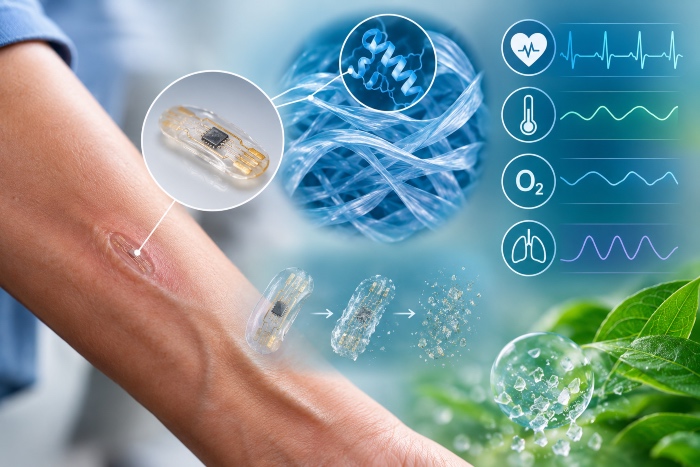
The design node around which the entire field of fibroin-based implantable biosensors revolves is not biocompatibility, which is by now established, but the reconciliation of two antithetical requirements: maintaining functional stability across the full useful diagnostic window, and then resolving in a controlled manner, without a surgical retrieval procedure. It is on this tension — function versus programmed transience — that the technological maturity of the platform is decided, and every processing choice has to be read in this light.
Degradation kinetics and control of crystallinity
The primary lever is β-sheet content. In vivo degradation is an enzyme-mediated process whose rate depends as much on the proteases present at the site as on the properties of the material itself, and the crystalline fraction directly governs the device's useful-life window. β-sheet content mirrors the in vivo degradation time, which makes it possible to program transience by acting on solvent (water, methanol, HFIP), thermal history and annealing, as well as stress and strain during film formation. The breadth of the achievable window is remarkable: amorphous films dissolve in under ten seconds, whereas highly crystalline films can persist for up to roughly one year, thereby covering the entire applicative spectrum, from fast-resolution transient sensors to long-term implants that nonetheless retain resorbability.
It is worth stressing that the mechanism is not a simple uniform surface erosion. The tightly packed β-sheet crystalline domains degrade more slowly, yielding through hydrophobic collapse and interaction with water, while the surrounding semi-amorphous matrix is attacked first. This structural hierarchy — β-sheet nanocrystals dispersed in a semi-amorphous protein matrix — is the same one that endows the material with the mechanical and dielectric properties the implant demands, and for the designer this means that tuning of degradation kinetics and tuning of mechanical performance are not independent variables but must be optimized simultaneously.
the water problem and transducer stability
The flip side of resorbability is the vulnerability of the operating device in an aqueous environment. The action of water molecules on intermolecular hydrogen bonds induces a transition toward a swollen, random-coil structure, causing rapid disconnection of the metallic conductive structures and functional failure of the device. This is where the real engineering criticality resides: the very substrate that must dissolve destabilizes interconnects and transducers through swelling well before the intended time window, and delamination at the fibroin–metal interface becomes the dominant failure mode. The design strategy cannot therefore limit itself to selecting high crystallinity as a guarantee of durability, because what is needed is fine management of the conformational state that preserves the intrinsic properties of silk while stabilizing in vivo operation. The excellent dielectric properties of fibroin remain, on the other hand, a decisive asset, since they provide reliable insulation to the electronic components that the aqueous environment would otherwise short-circuit.
Transduction architectures for vital signs
On the piezoresistive front, for pressure and the pulse waveform, morphological templating has delivered the most robust results. By combining rose-petal templating with hollow carbon nanospheres, a fibroin-based wearable electronic was obtained with a sensitivity of 5.63 kPa?¹, a response time of 147 ms and stability over 15,000 cycles, with degradation demonstrated at end of life — a set of metrics that makes the approach credible for continuous monitoring of cardiac and respiratory activity.
On the electrochemical front, for metabolites in biological fluids, the most mature direction is that of fully organic systems. Fully organic three-electrode configurations, with a sericin-based conductive ink micropatterned onto a fibroin substrate and interconnects made of a conducting polymer sheathed in fibroin, have shown performance metrics competitive with conventional systems, retaining function for several days before failing through biodegradation. Eliminating every non-degradable metallic or synthetic component resolves at the root both the problem of biological risk from residues and that of e-waste, and is probably the trajectory destined to prevail for transient metabolic biosensors.
Alongside these, in vivo electrophysiological recording — ECG, EMG, neural signals — imposes the most severe requirements of prolonged interface stability, and is the area in which conductive modification of fibroin is pushed furthest. It should be borne in mind, however, that at the current state of the art fibroin conductive films are suited above all to short-term implantable biosensors, biodegradable neural electrodes and conductive scaffolds for tissue engineering: genuinely long-term recording remains the hardest front to consolidate.
The in vitro / in vivo divide
One point that deserves critical attention, because it bears directly on the reliability of useful-life predictions, is the poor transferability of degradation data from bench to organism. The enzymatic pool present at the implant site differs from the one used in in vitro protocols, and this makes laboratory kinetic estimates weakly predictive of real behavior. Recent work is addressing the problem with hybrid modeling approaches: semi-empirical frameworks based on Gaussian Process Regression have been developed to bridge the kinetic mismatch between in vitro and in vivo environments, and the resulting data recalibrate some entrenched assumptions. In particular, a multi-stage physical disintegration is observed, following a topochemical erosion pathway that preserves the β-sheet crystalline structures despite the loss of mass and mechanical properties at the macroscopic scale. The design consequence is anything but marginal: the loss of functional mechanical integrity of the device can precede the disappearance of the crystalline domains by a wide margin, so that the perceived "end of life" and the material "end of life" do not coincide, and must be treated as two distinct parameters in sizing the implant.
Integration and outlook
The limit that today holds back the transition from the single validated sensor to the complete implantable system no longer lies so much in the material as in integration. Research remains fragmented across individual sensing domains, and a unified multiphysics framework capable of coupling optical, thermal, electrical and electrochemical transduction mechanisms within a single platform is still lacking — a necessary condition for truly integrated, energy-autonomous systems. The lines of work converge on three axes: self-powering, to free the implant from external sources consistently with its transient nature; processing strategies that stabilize operation in an aqueous environment without sacrificing resorbability; and the integration of AI-driven analysis, both for signal interpretation and for patient-specific prediction of degradation kinetics. It is on this last front — the ability to reliably predict the in vivo transience trajectory of the individual device — that the leap from proof-of-concept to clinical translation will presumably be measured.
