
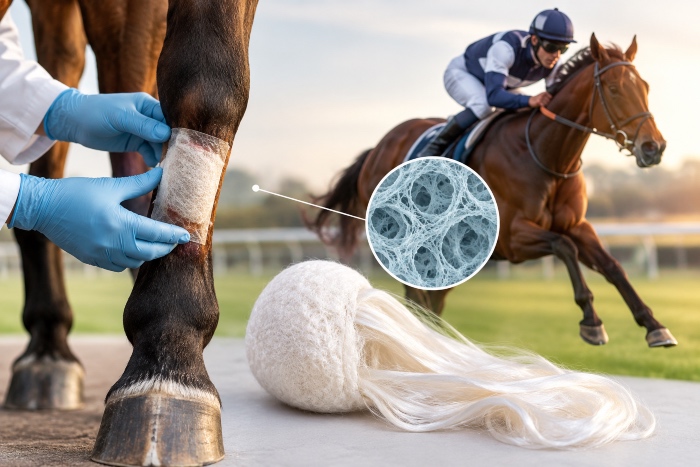
In the sport horse, distal limb wounds are far more than a traumatological inconvenience. They are one of the leading causes of interruption of athletic activity, of early retirement and, in the worst cases, of euthanasia, to the point that several reviews rank cutaneous injuries among the foremost causes of death in the equine species. The difficulty does not lie in the initial surgical gesture, which is almost always straightforward, but in the biology of tissue repair in an anatomical region that seems designed to heal poorly. It is against this backdrop that silk-derived biomaterials, and sericin in particular as a functional complement to the more established fibroin, offer an interesting mechanistic rationale that has yet to be validated in the veterinary clinical setting.
Why the distal limb of the horse heals poorly
Repair of distal limb wounds almost always proceeds by second intention, since the scarce soft-tissue coverage and the high cutaneous tension rarely allow a stable primary closure. In the metacarpus and metatarsus, this healing modality runs up against a set of unfavourable conditions that the veterinary literature has characterised with growing precision. Vascularisation is reduced, muscular support is minimal, motion at the site is constant, and the risk of contamination is high because of the proximity to the ground. To these anatomical variables is added a physiological peculiarity documented in equine experimental models, namely a weak yet protracted acute inflammatory phase which, rather than resolving, tends to become chronic within an ischaemic and hypoxic microenvironment.
The consequence is that wound contraction, the dominant mechanism in truncal healing, contributes little to the closure of limb lesions, where the process depends disproportionately on re-epithelialisation. When this fails to keep pace with the deposition of connective tissue, the wound sets off along the pathological trajectory that every equine practitioner recognises, that of exuberant granulation tissue.
Exuberant granulation tissue as a fibroproliferative disorder
Exuberant granulation tissue, known clinically as "proud flesh", is an excessive and almost tumour-like overgrowth of the granulation bed that extends beyond the wound margins and remains devoid of epithelial cover. It is not a mere quantitative excess of healthy tissue but a genuine disorder of second-intention healing, sustained by hyperproliferating fibroblasts, by anomalous keratinocyte differentiation, and by a poorly oriented myofibroblast population that impairs both contraction and re-epithelialisation. Recent immunohistochemical studies have described an abundance of CD163-positive macrophages in the fibrotic region and a collagen composition reflecting immaturity of the extracellular matrix, with increased synthesis but reduced degradation of collagen.
The most frequently cited parallel is with the human keloid, another fibroproliferative disorder in which the scar remains trapped in the proliferative phase. The economic and clinical impact is considerable, with prolonged and costly treatments and a share of patients, estimated at up to a quarter of the total in the most-cited works, who go on to experience reduced performance, early retirement or euthanasia. Understanding this pathogenesis is the indispensable premise for evaluating any advanced dressing, because a material that acts on fibroblasts indiscriminately may prove far from neutral in precisely the region where fibroblast proliferation is the problem, and not the solution.
Sericin as a bioactive protein
Fibroin is by now an established biomaterial, used as a load-bearing structure in dressings, scaffolds and films for skin regeneration thanks to its mechanical stability, its biodegradability and its low immunogenicity. Sericin is the complementary protein component of the Bombyx mori cocoon, the hydrophilic fraction that coats and cements the fibroin fibres and that the degumming process traditionally discards as a by-product. It is precisely this history as waste that delayed its study as a material in its own right, while research over the past decade has sharply reappraised its biological value.
In compositional terms sericin is rich in polar amino acids, in particular serine, glycine and aspartic acid, which account for its high hydrophilicity and its capacity to bind water. Coupled to this structure is a set of properties documented in in vitro and in vivo models that make it attractive for tissue repair, namely antioxidant, antibacterial, anti-inflammatory, photoprotective and moisturising activity. The combination is not trivial, because it gathers within a single molecule some of the functions sought in a bioactive dressing, functions that normally require the addition of external active agents.
The mechanisms relevant to wound repair
The first mechanism of interest is the control of oxidative stress. Chronic wounds, including equine distal limb wounds, are characterised by a redox imbalance with overproduction of reactive oxygen species that perpetuates inflammation and hinders progression towards an orderly proliferative phase. Sericin acts as a scavenger of free radicals and enhances the antioxidant enzymes in the injured area, helping to restore redox balance and to protect cellular integrity. In an environment such as that of the distal limb, dominated by protracted inflammation and altered redox, this mechanistic target is particularly pertinent.
The second mechanism is the containment of bacterial load. Contamination is a recognised factor in delayed healing and in proud flesh formation, and sericin possesses intrinsic antibacterial activity, attributed in part to the cationic nature of some of its fractions that interact with negatively charged bacterial membranes. This activity, modest in isolation, becomes clinically significant in composite materials, where sericin has been combined with chitosan, polyvinyl alcohol, alginate, gelatin, zinc ions, glycyrrhizic acid or metal nanoparticles to obtain hydrogels and films with a broad antimicrobial spectrum and sustained release. Antibacterial and antioxidant hydrogels free of antibiotics have also been described, an aspect of relevance in the perspective of reducing selective pressure and resistance.
The third mechanism bears directly on wound closure. Sericin promotes the adhesion and proliferation of fibroblasts and keratinocytes, stimulates collagen deposition and, thanks to its high water-absorption capacity, maintains a moist environment that accelerates epithelialisation. To this is added an immunomodulatory action documented in vitro, with induction of anti-inflammatory cytokines and polarisation of macrophages towards the reparative M2 phenotype, particularly evident for the low-molecular-weight fractions. Since the healing of equine limbs depends disproportionately on re-epithelialisation, the capacity to support keratinocyte migration and proliferation in a moist bed with low bacterial load is, on paper, exactly what is needed.
