
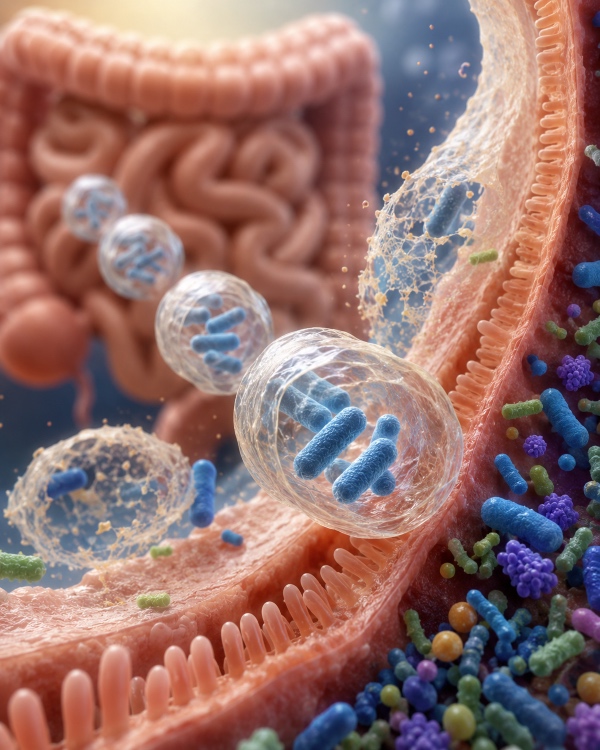
The promise of probiotics has long collided with a physiological obstacle that is difficult to circumvent. For a bacterial strain to express its therapeutic potential, it must reach the intestine in sufficient quantities and in a viable condition, yet the path from the mouth to the colon is anything but hospitable. Gastric pH, which in the fasting stomach can drop below a value of two, the bile salts released into the duodenum, and the proteolytic and pancreatic enzymes together form a sequence of chemical filters designed by the body precisely to break down unwanted microbial loads. Within this context sericin, a protein until a few years ago regarded as little more than a waste product of silkworm processing, is emerging as an encapsulation material capable of ferrying living microorganisms past the digestive barriers, returning to the intestinal microbial community strains that are still active and metabolically competent.
The challenge of gastrointestinal survival of live strains
Anyone who works with lactic acid bacteria is familiar with the gap between the count declared on the label and the one that actually colonizes the intestine. Repeated studies have documented how the majority of probiotics administered in free form lose viability already in the early stages of transit, with reductions that frequently exceed several orders of magnitude between ingestion and arrival in the distal intestinal tract. The problem concerns not only the number of cells that survive, but also their functional state, because a bacterium stressed by the acidic environment may still be culturable and yet unable to adhere to the mucosa, produce useful metabolites, or compete effectively with the resident flora.
Traditional formulations have attempted to respond with coating and microencapsulation strategies based on alginate, chitosan, gelatin, and other hydrocolloids, achieving significant improvements but not without limitations. Alginate, for instance, offers good protection against gastric acidity but tends to be porous, allowing small aggressive molecules to diffuse toward the microbial core, and its stability depends critically on the presence of calcium ions that the intestinal environment can sequester. It is within this space for improvement that sericin finds its place, offering a profile of properties that addresses several needs simultaneously.
Why sericin in particular
Sericin is the adhesive protein that in the silkworm cocoon holds together the two fibroin filaments, acting as a natural cement. Rich in serine residues, with an abundance of hydroxyl, carboxyl, and amino groups, it presents a strongly hydrophilic structure and a remarkable capacity to form hydrogen bonds, characteristics that make it an ideal candidate for building protective matrices and films. For a long time the textile industry removed it and dispersed it into processing waters as refuse, but biomedical research has progressively recognized its value, aided also by the sustainability of a material otherwise destined for disposal.
What makes sericin particularly suited to probiotic encapsulation is the combination of several biological properties. It possesses a marked antioxidant activity, capable of neutralizing free radicals and mitigating the oxidative stress to which bacterial cells are exposed during transit. It exhibits cryoprotective and stabilizing properties, useful in the lyophilization and storage phases that precede administration, when cells risk damage from the formation of ice crystals or from dehydration. It also presents high biocompatibility and biodegradability, with a negligible inflammatory response, and its protein nature makes it sensitive to intestinal enzymatic digestion in a controllable way, opening the path to a release that follows the physiology of the digestive tract rather than opposing it.
The mechanism of protection along transit
The principle that governs an effective encapsulation system is that of differentiated protection along the path, that is, a barrier that resists where the environment is hostile and yields where release is desired. Sericin lends itself to this logic because its matrix, suitably crosslinked or combined with other biopolymers, maintains relative stability in the acidic environment of the stomach, where the hydrogen bonds and the compactness of the protein network limit the penetration of hydrogen ions and the escape of the cells.
In the passage toward the small intestine the scenario changes. The rise of pH toward neutrality and the presence of pancreatic proteases modify the matrix, make it progressively more permeable, and trigger its degradation, releasing the bacteria into the segment where they are meant to act. This pH- and enzyme-dependent behavior constitutes the most elegant advantage of the system, because it transforms protein digestion, which for free probiotics represents a threat, into the very mechanism of targeted release. Sericin, being a protein, is recognized and processed by the digestive apparatus within a temporal and spatial window consistent with arrival in the intestine, achieving a release that synthetic materials can only approximate.
To this structural protection is added a biochemical one. While the physical matrix shields the cells from direct contact with acids and bile salts, the antioxidant activity of sericin intervenes on the molecular damage, reducing the lipid peroxidation of bacterial membranes and preserving the functional integrity of the cellular envelopes. The result is a twofold line of defense acting on different planes, the barrier that keeps the insult at a distance and the molecular shield that mitigates its residual effects.
Formulation strategies and combined systems
In experimental practice sericin is rarely employed in pure form, because its high solubility in water, while an asset in many applications, requires precautions when the objective is to build a resistant capsule. The most promising strategies combine it with other polymers in hybrid systems that exploit their complementarities. Pairing with alginate, for example, unites the rapid ionic gelation of the latter with the bioactivity of sericin, generating microspheres in which the silk protein fills and seals the pores that alginate would leave open. Similarly, the combination with chitosan makes it possible to exploit the electrostatic interactions between the opposite charges of the two polymers to build denser and more selective multilayer coatings.
Production techniques range from gelation by extrusion or emulsion to spray drying, up to layer-by-layer deposition methods that alternate oppositely charged polyelectrolytes around the microbial core. Crosslinking, obtained physically through thermal treatments or freezing cycles, or chemically with agents that form covalent bonds between the protein chains, allows the density of the matrix and thus the release kinetics to be modulated. The choice of method is not neutral with respect to cell viability, because high temperatures, organic solvents, or aggressive crosslinkers can damage the probiotics as much as the gastric environment, and the search for mild conditions that preserve the cells during encapsulation remains one of the most delicate aspects of the entire process.
