
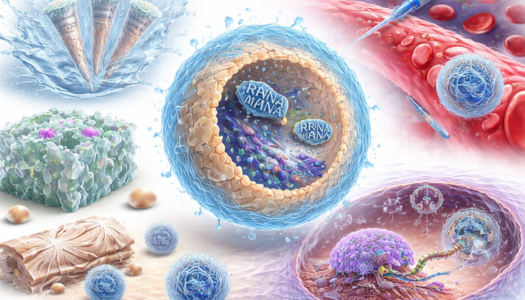
Even before discussing the solutions, it is worth dwelling on the central issue that makes RNA-based therapy so challenging. The main mechanisms of mRNA degradation include both physical and chemical degradation, with hydrolysis being the principal form of destruction: both self-cleaving nucleases and protein nucleases can compromise RNA stability through this mechanism. Added to this is the issue of thermal stability, since vaccines and mRNA constructs, in their conventional formulation, require cryogenic storage conditions, making their widespread global distribution a logistical undertaking of enormous complexity. It is in this context that fibroin has begun to attract attention as an unconventional yet extraordinarily promising candidate for the formulation of nucleic acid delivery systems. Its physicochemical and mechanical properties, controllable biodegradation, and FDA approval for specific medical applications make it an ideal candidate for the encapsulation and release of a wide range of drugs, from small molecules to biologics and nucleic acids.
The structural profile as a starting point for carrier design
Understanding the physicochemical properties of fibroin is essential to explain why it is so well suited to function as a carrier for nucleic acid molecules. Compared with other natural polymers, silk fibroin (SF) exhibits slower and more controllable degradation kinetics, as well as a high degree of adaptability through processing conditions. A key advantage is the possibility of engineering SF-based hydrogels with specific characteristics—injectable, self-healing, or stimulus-responsive—by controlling the gelation mechanism. This adaptability is concretely expressed in the multiple formal architectures that fibroin can assume. Unlike many other natural polymers, SF can be processed into a wide range of formats—including nanoparticles, hydrogels, nanofibers, and 3D scaffolds—without compromising its fundamental benefits. Such morphological versatility is not merely an aesthetic feature, but profoundly affects the release kinetics of the nucleic acid cargo, protection capacity against nucleases, and cellular internalization efficiency. However, it should be emphasized that native fibroin presents a negative surface charge at physiological pH—a characteristic that makes it biocompatible but at the same time unsuitable for directly complexing nucleic acids, which are also negatively charged. This limitation has opened a line of research dedicated to the chemical modification of the protein.
The most established strategy to enable fibroin for the direct complexation of nucleic acids is the cationization of the protein through the incorporation of polycationic polymers. In a representative study, low-molecular-weight polyethyleneimine (PEI, 1.8 kDa) was grafted onto the side chains of Bombyx mori fibroin through amide bonds, shifting the zeta potential from −11.8 mV to +12.4 mV and increasing the isoelectric point from 3.68 to 8.82. The resulting cationized CBSF was able to complex plasmid DNA, forming spherical CBSF/pDNA complexes and showing in vitro transfection efficiency superior to that of 25 kDa PEI/pDNA complexes, with significantly reduced cytotoxicity in normal cells. The advantage of this hybrid architecture goes beyond the mere reduction of toxicity. The resulting complexes resist digestion by nucleolytic enzymes and serum degradation, a fundamental attribute for any delivery system intended for in vivo use. In practice, fibroin acts as a biological shield around the genetic cargo, prolonging its plasma stability without the toxicity peaks typical of high-molecular-weight cationic polymers. A promising variant exploits spermine, a natural endogenous polycationic amine, as the cationization agent. In Antheraea pernyi fibroin modified with spermine, CASF/pDNA complexes show spherical morphology, average sizes of 215–281 nm, low cytotoxicity, and transfection efficiency superior to PEI/pDNA complexes.
An additional advantage of ASF over Bombyx mori fibroin lies in the presence of abundant RGD sequences in its amino acid composition, which confer passive targeting properties toward cells overexpressing integrins—a particularly interesting scenario for gene transfer in oncology.
siRNA as cargo and complexation dynamics
In the field of therapeutic RNA, siRNA imposes particularly stringent formulation requirements: it is a small molecule, highly negatively charged, with an extremely short plasma half-life without protection, and must reach the cellular cytoplasm where it exerts its RNA interference effect. In oligochitosan-fibroin nanoparticles used as a delivery system for siRNA, the siRNA loading capacity increased proportionally with the amount of fibroin, and these systems demonstrated much greater stability in the presence of serum and heparin compared with fibroin-free polyplexes, in addition to lower cytotoxicity and improved gene silencing effects. The co-delivery of siRNA and cytotoxic drugs represents a further application in which cationized fibroin nanocarriers show significant potential. SF nanoparticles modified with PEI for the co-delivery of metformin and anti-survivin siRNA demonstrated the ability to protect siRNA from degradation in the acidic endosomal environment, enabling the delivery of both genetic and pharmacological cargo with high specificity to tumor cells. The endosomal escape mechanism is based on the typical proton sponge effect of PEI, which becomes protonated in acidic environments and destabilizes the endosomal membrane, releasing the cargo into the cytoplasm before lysosomal degradation.
Thermostability and mRNA vaccines
One of the most concrete contributions that fibroin can offer to mRNA vaccinology concerns the thermal stabilization of the nucleic acid cargo, potentially making dependence on the cold chain unnecessary or at least reducible. The stabilization exerted by silk at elevated temperatures—those that cause vaccine deterioration in conventional formulations when the cold chain is interrupted, between 37°C and 45°C—suggests that silk films would be capable of providing sufficient stability across a broad range of storage temperatures. The molecular mechanism underlying this stabilization can be attributed to the ability of the protein matrix to reduce the molecular mobility of the encapsulated cargo, slowing the processes of hydrolysis, oxidation, and conformational denaturation. Lyophilized fibroin films combine the advantages of silk-based storage and lyophilization, further reducing protein mobility and improving stabilization compared with air-dried films. Applying this principle to transdermal vaccination, fibroin has proven to be a material of choice for the fabrication of microneedles incorporating biological vaccines. Bombyx mori fibroin possesses ideal properties for use in microneedle systems: fully aqueous processing, mechanical strength in dried formats, biocompatibility, and the ability to thermostabilize biomacromolecules. This biomaterial combines the processing and biocompatibility advantages typical of dissolvable microneedle systems with the product stability and mechanical strength of coated and insoluble microneedle systems.
Fibroin hydrogels as an immunological depot
One of the most elegant applications in the context of mRNA vaccines is the use of injectable fibroin hydrogels as sustained-release systems, allowing continuous antigen exposure over time and amplifying the immune response compared with a single bolus inoculation. In a vaccine system based on the RBD-Fc antigen, the SF hydrogel demonstrated ex vivo localized retention, with controlled and prolonged release of 75% and 25% of the antigen respectively over 60 days, promoting continuous interaction between the immune system and the viral peptide. This release profile is particularly valuable in immunology: prolonged and gradual antigen exposure tends to favor antibody affinity maturation, differentiation into memory B cells, and a more robust T helper response. In a subsserosal gastric vaccination model against Helicobacter felis, the fibroin hydrogel combined with the antigen carrier expanded the distribution of resident intraepithelial CD4+ TRM cells, with superior protection results compared with the conventional aluminum adjuvant formulation.
The modulation of release kinetics through the degree of beta-sheet crystallinity of fibroin offers the formulator an exceptionally fine control parameter, capable of orchestrating antigen presentation in such a way as to modulate macrophage polarization at the vaccination site.
