
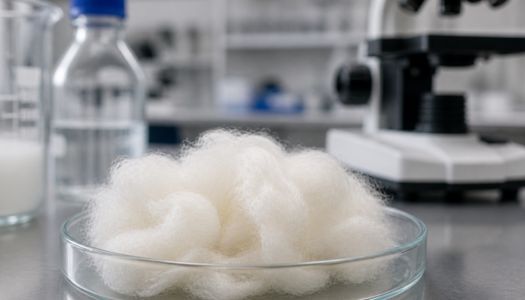
Fibroin is the main structural protein that makes up natural silk thread — that extraordinarily fine and remarkably strong substance produced by the silkworm, in its most domesticated species Bombyx mori, in the silk glands during the pupal stage. It is not simply a textile fiber: fibroin is a biological macromolecule refined over millions of years of evolution, capable of combining mechanical, chemical, and biological properties that no synthetic material has yet been able to fully replicate.
The raw silk produced by the silkworm is composed of two parallel fibroin filaments held together by an outer protein layer called sericin. The latter acts as a natural glue, giving the fiber its characteristic luster and the smooth feel we know from textile use. But fibroin is the true protagonist — the structural core from which all the mechanical and biological properties of this extraordinary material derive.
At the molecular level, fibroin belongs to the family of fibrous proteins, those that adopt elongated and regular spatial configurations rather than the globular forms typical of enzymes. Its amino acid chain is dominated by a repeated sequence of just five amino acids — glycine, alanine, serine, tyrosine, and valine — which organize themselves into crystalline structures called beta-sheets, specifically antiparallel beta-sheets. This organization grants the protein exceptional rigidity and strength, while still maintaining a degree of flexibility thanks to the amorphous regions that alternate with the crystalline zones. The predominant amino acid sequence of fibroin is the repeating unit (Gly-Ala-Gly-Ala-Gly-Ser)?, a structure already naturally optimized to form highly stable antiparallel beta-sheets. It is precisely this repetitive structural simplicity that makes fibroin so versatile and processable in the laboratory.
The molecular structure in depth
To fully understand fibroin's behavior, one must descend to the nanometric level and observe how protein chains organize themselves in space. The fibroin of Bombyx mori is composed of three distinct protein subunits: a heavy chain (H-chain) with a molecular weight of approximately 350 kDa, a light chain (L-chain) of around 25 kDa, and an accessory glycoprotein called P25, which contributes to the stabilization of the protein complex. The heavy chain is primarily responsible for the mechanical properties, as it contains the highly crystallizable repetitive sequences.
The crystalline regions of fibroin — which account for approximately 60–65% of the total structure — are organized into antiparallel beta-sheets held together by intermolecular hydrogen bonds. These bonds, although individually weak, become extraordinarily effective when multiplied across billions of repetitions along the length of the fiber: this is the mechanism that explains silk's almost legendary tensile strength. The amorphous regions, by contrast, are more disordered and confer elasticity, allowing the fiber to withstand deformation without breaking outright.
A fascinating aspect of fibroin's structure is its ability to adopt different conformations depending on processing conditions. In aqueous solution, for example, fibroin can assume a random coil or alpha-helix conformation, which then progressively transforms into a beta-sheet as the solution is dried, mechanically stretched, or exposed to methanol vapor. This conformational transition is the foundation of all fibroin processing technology in the laboratory.
From silkworm to laboratory
The journey from raw silk to biomedical or technological applications is long and complex, involving a series of chemical and physical steps that deserve to be described in detail.
The silkworm produces its thread by wrapping itself in a continuous cocoon that can reach 900 to 1,500 meters in length. The cocoons are harvested before the moth emerges in order to preserve the integrity of the thread. The industrial process involves boiling the cocoons in water at approximately 95°C to soften the sericin and allow the raw thread to be unwound.
To obtain pure fibroin, the sericin coating it must be removed through a process called degumming. The most common technique involves boiling the silk in a sodium carbonate solution (0.02 M Na?CO?) at 98°C for 30 minutes. Alternative treatments use enzymatic proteases such as trypsin or Actinase, which allow a more selective and less invasive removal of sericin.
The degummed fibroin is then dissolved in a chaotropic salt — typically lithium bromide (9.3 M LiBr) at 60°C for 4 hours — which breaks the hydrogen bonds and brings the protein into solution. Alternatively, the ternary system CaCl?/EtOH/H?O (molar ratio 1:2:8) is equally effective and less aggressive. The resulting solution is then dialyzed against distilled water for 48 to 72 hours using low-cutoff membranes to remove the salt, yielding an aqueous fibroin solution ready for further processing.
From this aqueous fibroin solution — typically at 2–8% by weight — a surprisingly wide variety of physical forms can be produced: thin films by controlled evaporation, hydrogels by ultrasound- or enzyme-induced cross-linking, three-dimensional porous scaffolds by freeze-drying, nanofibers by electrospinning, microspheres by spray drying, and even regenerative fibers for 3D bioprinting.
Controlling crystallinity and post-treatments
The final material can be stabilized through treatment with methanol or 70% ethanol vapor, which induces the conformational transition toward a beta-sheet structure, rendering it insoluble in water. Alternatively, treatment with water vapor at high relative humidity (above 80%) for 24 hours ensures greater biocompatibility compared to organic solvents, and is the preferred technique for biomedical applications.
What makes fibroin a truly unique material is not a single exceptional property but the synergistic combination of characteristics that do not normally coexist within the same material. Let us explore the main ones in detail.
Mechanical properties
Native silk fiber exhibits a tensile strength that can reach 740 MPa, a value comparable to high-carbon steel when compared on a weight-for-weight basis. Elongation at break ranges from approximately 15 to 35%, an excellent compromise between stiffness and elasticity. The Young's modulus varies between 5 and 17 GPa depending on fiber orientation and degree of crystallinity. These properties can be tuned in regenerated materials: crystallized films display greater rigidity, while hydrogels exhibit viscoelastic behavior similar to soft biological tissues.
Biocompatibility and biodegradability
Fibroin is recognized by the US FDA as a biocompatible material for human use. Once implanted in the body, it does not provoke significant immune responses — provided that sericin has been completely removed, since it is sericin that triggers the main allergic or inflammatory reactions. Biodegradation occurs through the action of proteolytic enzymes present in the biological environment (primarily proteases and collagenases) and can be calibrated by modifying the degree of crystallinity: highly crystalline materials can persist for months or years, while amorphous forms degrade within weeks.
Optical transparency and photonic properties
Thin fibroin films are optically transparent in the visible range, with transmittance exceeding 90% for thicknesses below 100 microns. This property, combined with the possibility of incorporating chromophores, quantum dots, or fluorescent molecules into the protein matrix, opens up highly interesting scenarios for applications in photonics, biosensing, and optical diagnostics.
Electrical and piezoelectric properties
One of the least known but scientifically most fascinating aspects of fibroin is its piezoelectric response: when subjected to mechanical deformation, it generates a measurable electric charge. This behavior, discovered relatively recently, makes it a promising candidate for the fabrication of ultrasensitive pressure sensors, energy harvesters for wearable devices, and flexible neural interfaces.
Applications of fibroin
Tissue Engineering
Porous fibroin scaffolds are used as structural frameworks for the growth of chondrocytes, osteoblasts, and mesenchymal stem cells, mimicking the native extracellular matrix.
Neurology
Fibroin conduits guide axonal regrowth in damaged peripheral nerves, with results comparable to autologous grafts in animal models.
Drug Delivery
Fibroin microspheres, nanoparticles, and films can encapsulate active compounds — antibiotics, growth factors, antibodies — releasing them gradually and in a controlled manner over time.
Ophthalmology
Ultra-thin fibroin films are being investigated as a support for corneal engineering and as a substrate for the culture of corneal epithelial cells, owing to their transparency and biocompatibility.
Flexible Electronics
Dissolvable fibroin is used as a temporary substrate for flexible neural electrodes that degrade after implantation, eliminating the need for a second surgical procedure.
Advanced Cosmetics
Fibroin hydrolysates rich in serine and glycine are incorporated into cosmetic formulations for skin hydration and renewal.
Fibroin in tissue engineering and regenerative medicine
Among all of fibroin's applications, the one that has received the greatest scientific attention over the past two decades is undoubtedly tissue engineering. This protein's ability to form three-dimensional scaffolds with controllable porosity, combined with its excellent biocompatibility, makes it an ideal material for reconstructing complex tissues such as bone, cartilage, ligaments, tendons, blood vessels, and even cardiac tissue.
The mechanism underlying this application is relatively intuitive: the cells of the human body, in order to proliferate and differentiate correctly, need to adhere to a three-dimensional structure that mimics the natural extracellular matrix. Fibroin, thanks to arginine-glycine-aspartate (RGD) sequences present in some modified variants, can directly promote cell adhesion through binding to surface integrins. This characteristic, combined with the material's controlled biodegradability, makes it possible to construct scaffolds that will progressively dissolve as new tissue replaces them, without leaving any toxic residues.
Particularly promising research has demonstrated that fibroin can be combined with hydroxyapatite (the mineral constituent of bone) to create highly effective osteomimetic composites, or with gelatin and chondroitin sulfate to reproduce the cartilaginous matrix. Research groups around the world — including the laboratory of David Kaplan at Tufts University, one of the absolute pioneers in this field — have achieved remarkable results in bone regeneration, meniscal repair, and the cultivation of artificial intervertebral discs.
