
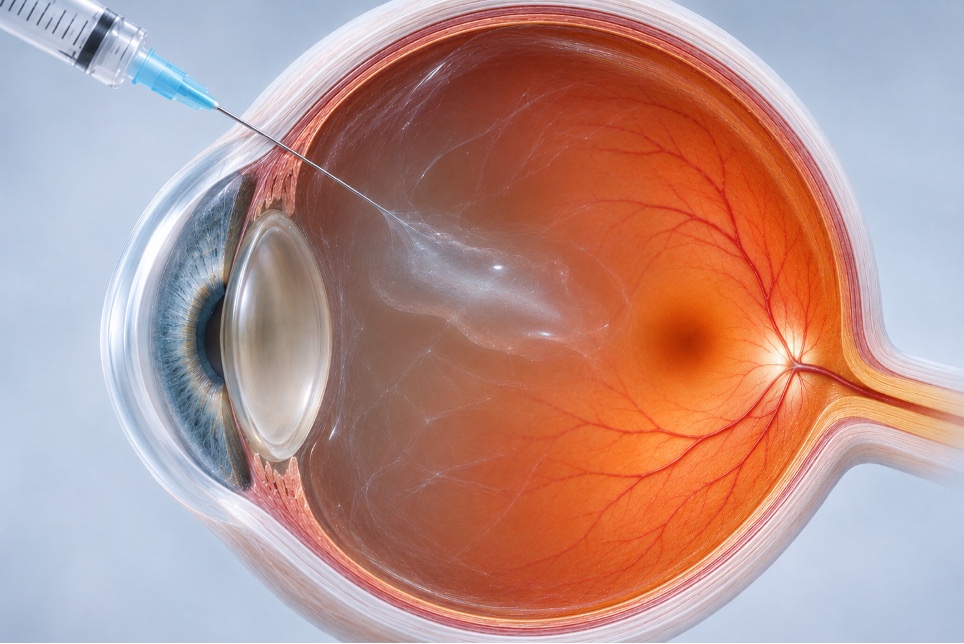
Sustained Drug Delivery in Retinal Therapies
Neovascular age-related macular degeneration, diabetic macular edema, and macular edema associated with retinal vein occlusion are among the retinal diseases treated with drugs that inhibit vascular endothelial growth factor (VEGF). These therapies counteract abnormal blood vessel formation and increased vascular permeability, helping to preserve visual function.
Maintaining treatment efficacy often requires repeated intravitreal injections. Following administration, drug concentrations in the vitreous progressively decrease. Sustained-release systems aim to extend drug availability at the target site, potentially increasing the intervals between administrations while maintaining adequate therapeutic exposure.
Silk Fibroin Hydrogels: Structure and Properties
Silk fibroin, mainly obtained from the cocoons of Bombyx mori, can form hydrogels consisting of a highly hydrated protein network. This structure enables the incorporation of therapeutic molecules and controls their diffusion through the matrix. The possibility of preparing the matrix under aqueous conditions makes it particularly suitable for antibodies and other therapeutic proteins, whose molecular structure must be preserved.
Fibroin concentration and gelation conditions influence the network characteristics, formulation stability, and diffusion rate of the incorporated molecules. By adjusting these parameters, release profiles can be tailored to the properties of the active ingredient and the desired treatment duration.
For intravitreal administration, the rheological properties of the hydrogel are also important and must allow injection through an appropriately sized needle. The matrix must retain a suitable structure to regulate drug release after administration.
Release Kinetics and Stability of Biologic Drugs
Drug release from hydrogels depends on diffusion through the protein network, interactions between the drug and the matrix, and structural changes in the material over time. Formulation design allows both the diffusion rate and the initial release phase (burst release) to be modulated, establishing a release profile consistent with the intended treatment duration.
For monoclonal antibodies and fusion proteins, controlling release kinetics must be combined with verifying the integrity and biological activity of the released drug. Characterization therefore involves not only quantifying the amount of active ingredient released but also performing functional assays to confirm its interaction with the biological target.
An example reported in the literature is the study by Lovett and colleagues on silk fibroin hydrogels containing bevacizumab. The formulations enabled sustained drug release for at least three months, both in vitro and after intravitreal administration in rabbits, while preserving the drug’s biological activity. These results highlight the potential of silk fibroin to extend the availability of therapeutic molecules while maintaining their functionality.
Development of Formulations for Intravitreal Use
Hydrogel evaluation includes the characterization of drug release in vitro and the investigation of drug persistence in the ocular environment in vivo. These analyses make it possible to correlate formulation characteristics with drug concentrations in the vitreous and biological activity over time.
Formulation design must simultaneously consider injectability, ocular compatibility, optical transparency, and the degradation characteristics of the biomaterial. Formulation reproducibility and the development of preparation and sterilization processes compatible with the incorporated proteins are equally important. Together, these parameters contribute to defining the quality and performance of the drug delivery system.
Perspectives for Ophthalmic Applications
The versatility of silk fibroin enables the development of hydrogels with properties that can be tailored to the requirements of different therapeutic molecules. The main interest in this technology lies in the possibility of combining controlled diffusion, drug stability, and injectable administration within a single formulation.
For retinal diseases, this combination represents a promising strategy to extend exposure to biologic drugs and reduce the frequency of administration. This application highlights how the properties of silk proteins can be exploited in the design of innovative ophthalmic formulations.
References
Lovett M.L. et al. (2015). Silk hydrogels for sustained ocular delivery of anti-vascular endothelial growth factor (anti-VEGF) therapeutics. European Journal of Pharmaceutics and Biopharmaceutics, 95, 271–278.
Pollini M., Paladini F. (2024). The Emerging Role of Silk Fibroin for the Development of Novel Drug Delivery Systems. Biomimetics, 9(5), 295.
Chacin Ruiz E.A., Swindle-Reilly K.E., Ford Versypt A.N. (2023). Experimental and mathematical approaches for drug delivery for the treatment of wet age-related macular degeneration. Journal of Controlled Release, 363, 464–483.
