
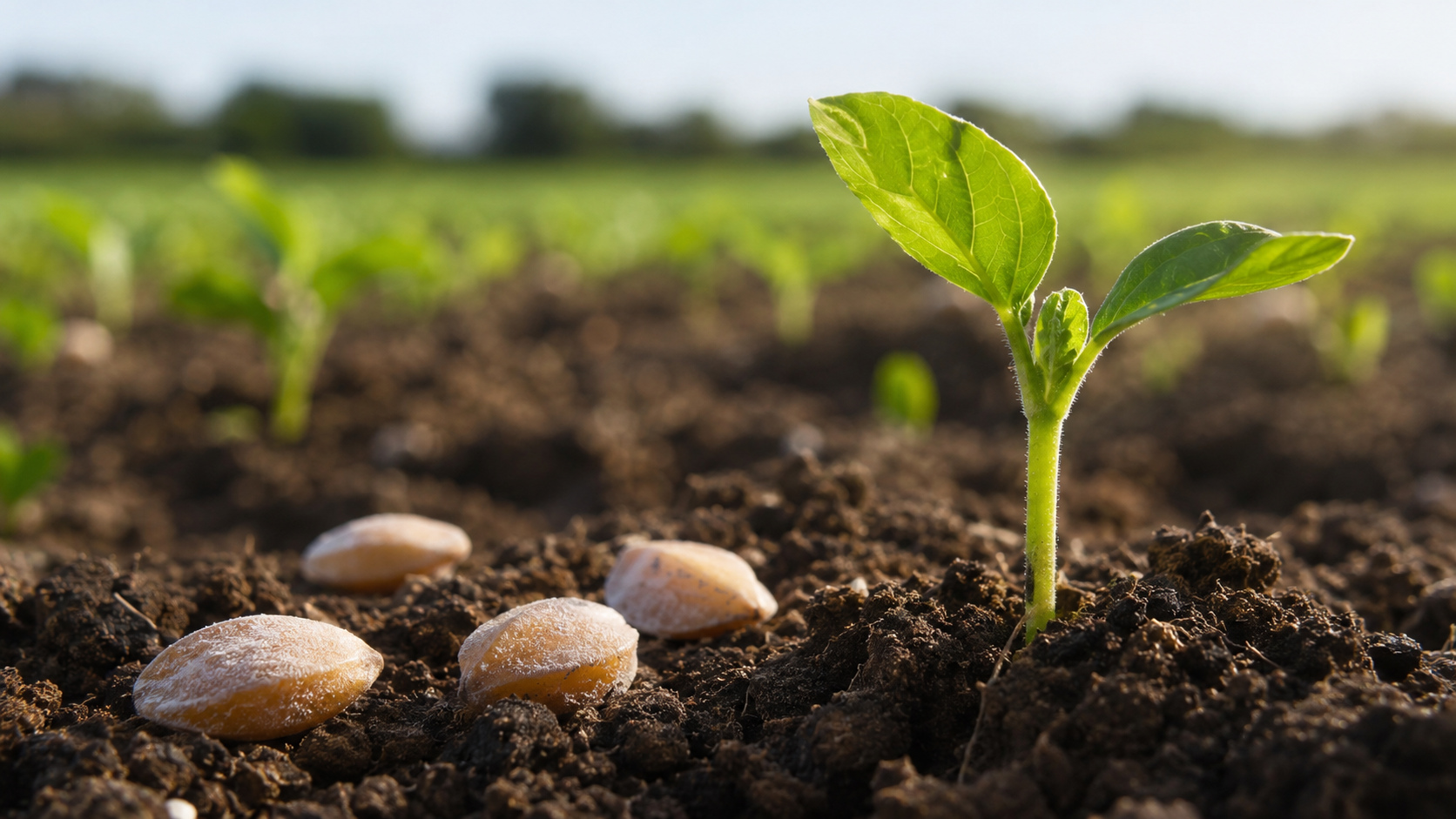
Every harvest begins with a seed, but germination is one of the most delicate stages of plant development. Water scarcity, soil salinity, unfavorable temperatures, and pathogenic microorganisms can compromise seedling emergence, affecting crop productivity.
What if a thin, natural coating could protect seeds while also promoting their development?
This is one of the opportunities offered by silk fibroin, a natural protein attracting growing interest in agriculture due to its potential to form biodegradable coatings capable of incorporating beneficial substances and microorganisms.
A Coating That Protects and Promotes Growth
Seed coating is a widely used agricultural technology that involves applying a protective layer to the seed surface, potentially containing nutrients, crop protection agents, or other functional components.
Silk fibroin can be processed into thin films with properties tailored to specific applications. Its ability to be processed in aqueous environments and combined with other biopolymers enables the design of coatings that protect seeds while preserving the water and oxygen exchange required for germination.
Its potential, however, extends beyond physical protection: the coating can act as a functional matrix that incorporates and delivers biologically active components directly to the seed surface and its surrounding environment.
Beneficial Microorganisms and Protection Against Environmental Stress
One of the most promising applications involves incorporating plant growth-promoting rhizobacteria (PGPR), microorganisms that can stimulate root development, improve nutrient availability, and enhance plant responses to environmental stress.
Their effectiveness also depends on maintaining viability during storage and application. Silk fibroin-based coatings can help protect these microorganisms and facilitate their localized delivery near the seed, promoting subsequent contact with the developing root system.
Another opportunity lies in water management. By combining silk fibroin with water-absorbing and moisture-retaining biopolymers, multilayer coatings can be designed to support germination even under conditions of limited water availability.
The same matrix can also incorporate nutrients, antimicrobial agents, or biological crop protection components, aiming to deliver them locally while limiting their dispersion into the surrounding environment.
These functions can be integrated into a single coating, combining seed protection, germination support, and the promotion of early plant growth.
Sustainability and Future Applications
Interest in these coatings also stems from their environmental potential. As a naturally derived protein susceptible to biological degradation, silk fibroin represents a possible alternative to certain persistent polymeric materials.
This topic is particularly relevant in light of Commission Regulation (EU) 2023/2055, which introduces restrictions on intentionally added synthetic polymer microparticles, including certain agricultural applications.
For industrial-scale implementation, the main challenges include formulation stability, compatibility with existing seed treatment processes, and balancing material costs against agronomic benefits.
The value of silk fibroin lies in its potential to transform a simple protective coating into a multifunctional system that supports germination and crop development, opening new opportunities for more efficient and sustainable agriculture.
References
Zvinavashe A.T. et al. (2021). Programmable design of seed coating function induces water-stress tolerance in semi-arid regions. Nature Food, 2, 485–493.
Mhada M. et al. (2026). Silk-trehalose seed coating technology preserves Rhizobium tropici viability and enhances zinc biofortification in common bean under marginal soil conditions. Frontiers in Plant Science, 17, 1738866.
