
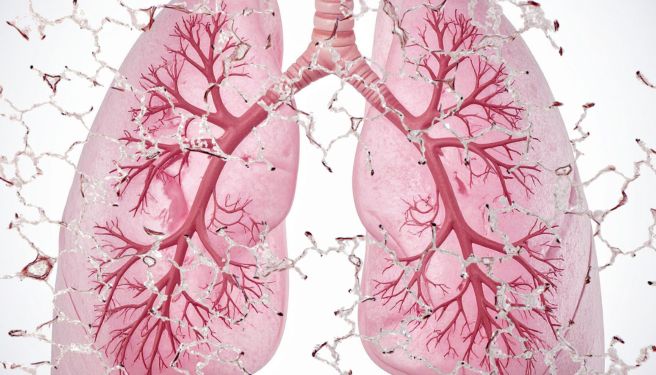
Chronic respiratory diseases, diffuse alveolar parenchymal injuries, and the structural consequences caused by severe infections have highlighted the need to develop therapeutic approaches capable of acting directly on cellular repair processes. In this context, fibroin has finally gained a central role in biomedical research focused on pulmonary tissue engineering, particularly due to its ability to create biologically compatible supports capable of promoting the reconstruction of the respiratory epithelium. Scientific interest is not limited exclusively to the structural aspect of the biomaterial, but also to its dynamic interaction with the cellular microenvironment, a decisive element in alveolar regeneration processes and in the stabilization of respiratory function.
Pulmonary microenvironment and epithelial repair
Pulmonary epithelial tissue possesses an extremely delicate biological balance. Any alteration of the alveolar barrier produces direct effects on gas exchange, local immune regulation, and the lung’s ability to maintain proper functional elasticity. When damage becomes persistent, the physiological repair process tends to transform into a disorganized mechanism characterized by chronic inflammation, fibrotic deposition, and progressive loss of ventilatory capacity. Fibroin fits into this scenario as a biomaterial capable of supporting cellular regeneration through three-dimensional scaffolds designed to replicate the biomechanical characteristics of pulmonary tissue. The matrices developed for respiratory applications demonstrate a remarkable ability to support adhesion, proliferation, and differentiation of epithelial cells, promoting a more organized reconstruction of the alveolar barrier. The most interesting aspect concerns the possibility of modulating the material’s porosity, elasticity, and degradation in order to adapt it to different clinical needs and varying levels of lung damage. This approach is profoundly changing the very concept of regenerative respiratory therapy, shifting the focus from simple symptom control toward the biological recovery of tissue structure.
Fibroin and regenerative respiratory medicine
The applications of fibroin in advanced respiratory medicine are attracting increasing attention due to their potential integration with cellular medicine technologies and three-dimensional bioprinting. In the most advanced experimental models, fibroin-based supports are used to recreate biological microenvironments capable of promoting pulmonary re-epithelialization and limiting the progression of fibrotic processes. This aspect is particularly relevant in diseases characterized by chronic alveolar damage, where the loss of epithelial integrity accelerates the functional deterioration of the lung. Recent research is demonstrating that fibroin can act not only as a supporting structure, but also as a bioactive platform capable of directly influencing cellular behavior. Its interaction with mesenchymal stem cells and growth factors opens highly advanced perspectives for regenerative respiratory therapy. The objective is not merely to reconstruct damaged tissue, but to create biological conditions favorable to the formation of a stable functional epithelium capable of integrating with the surrounding parenchyma without generating aggressive inflammatory responses. In respiratory medicine, this evolution could represent a therapeutic paradigm shift destined to profoundly impact the management of degenerative pulmonary diseases.
Pulmonary tissue engineering and new clinical applications
Fibroin is currently being studied as a key element in the design of biomimetic scaffolds intended for the reconstruction of damaged epithelial tissue. The possibility of controlling the mechanical properties of the material makes it possible to create highly specialized structures capable of adapting to respiratory movements and supporting progressive cellular maturation. Research laboratories are focusing particular attention on applications dedicated to chronic obstructive pulmonary disease, idiopathic pulmonary fibrosis, and post-infectious damage compromising alveolar functionality. In these clinical contexts, fibroin could become a multifunctional therapeutic platform capable of combining structural support, controlled release of bioactive molecules, and modulation of local inflammation. A further development concerns respiratory drug delivery, a field in which fibroin offers interesting perspectives for the targeted administration of regenerative agents directly into damaged areas of the lung. This approach could significantly improve therapeutic efficacy while simultaneously reducing the systemic effects associated with traditional pharmacological treatments.
The future of pulmonary epithelial regeneration
Respiratory medicine in the coming decade will increasingly move toward strategies focused on the biological reconstruction of pulmonary tissue. Fibroin represents one of the most promising biomaterials within this evolution because it enables the development of therapeutic solutions capable of integrating biocompatibility, mechanical support, and biological activity within a single regenerative system. New experimental platforms are demonstrating that the combination of fibroin scaffolds, regenerative cells, and advanced bioengineering can promote the formation of functional respiratory epithelia with characteristics very close to physiological conditions. This result has strategic value especially in patients affected by progressive chronic diseases, where the deterioration of alveolar structure represents one of the main negative prognostic factors. The objective of research is not limited to slowing disease progression, but extends to the concrete possibility of recovering part of respiratory functionality through controlled regeneration processes. Future perspectives include the development of bioartificial grafts, bronchial reconstruction systems, and personalized therapeutic platforms designed according to the biological characteristics of individual patients.
