
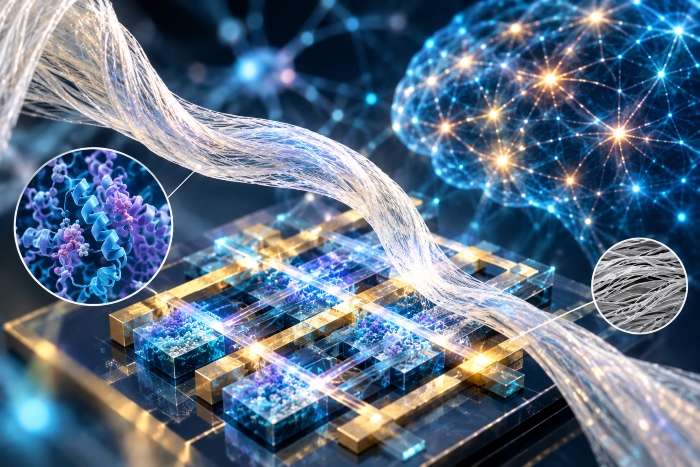
Why a biological memristor
Neuromorphic computing requires analog memory elements able to modulate their conductance as a function of stimulus history, in analogy with synaptic plasticity. Inorganic oxide memristors have reached considerable maturity, but they are not designed to interface with tissue or to be degraded at the end of their life. Implantable and wearable electronics, by contrast, call for flexible, biocompatible and sometimes transient materials, a niche in which protein dielectrics have concrete arguments in their favor.
It should be made clear that the term memristor, in the context of organic and protein materials, is often used loosely to describe any device showing pinched current-voltage hysteresis, whereas the original theoretical definition presupposes a specific relationship between charge and flux. For a technical reader it is worth distinguishing the cases in which switching depends on a genuine resistive memory mechanism from those in which the hysteresis is due to capacitive effects, trapped charge or ionic relaxation, which can produce similar curves without any true non-volatile memory function.
Switching mechanisms
In metal-insulator-metal devices with a fibroin active layer, resistive behavior has been attributed to two families of mechanisms. With electrochemically active electrodes, such as silver, the formation and dissolution of conductive filaments prevails, whereas with inert electrodes the contribution is often linked to the transport of ions and protons mediated by the water bound to the matrix and by the ionizable groups of the side chains. The distinction has practical consequences, because metallic filaments offer high on/off ratios but greater cycle-to-cycle variability, while ionic mechanisms favor gradual modulation and therefore a more authentically synaptic behavior.
The moisture content and the secondary structure of the active layer markedly influence switching thresholds, retention and variability, so that control of the processing environment and of encapsulation is an integral part of the design and not a detail.
Fabrication of the active layer, typically by spin coating of aqueous solutions, requires careful control of thickness, on the order of a few tens of nanometers, and of surface morphology, because roughness and the presence of local defects affect the electric field and the formation of conductive paths. Post-deposition treatment, whether with water vapor or with alcohols, alters the ratio between amorphous and crystalline regions and therefore ionic mobility, with direct effects on set and reset voltages and on device-to-device variability.
Synaptic functions and relevant metrics
Long-term potentiation and depression, spike-timing-dependent plasticity and paired-pulse facilitation have all been demonstrated. For use in hardware neural networks, however, more demanding metrics matter, such as the linearity and symmetry of weight updates, the number of distinguishable states, endurance in cycles, retention and device-to-device variability. In these dimensions protein memristors are still far from the performance of oxide-based systems, and their interest lies chiefly in applications where flexibility, transparency, biodegradability and low processing cost weigh more than integration density.
For neuromorphic applications, the possibility of building crossbar structures is also relevant, since they allow multiply-and-accumulate operations to be carried out directly in memory. The typical problems of such arrays, such as sneak-path currents and device variability, are amplified in organic materials, and must be addressed with selector elements or with programming strategies that tolerate non-ideality, such as hardware-noise-aware training.
Limits and plausible applications
The main weakness is stability in humid air and at body temperature, which calls for barrier layers or cross-linked formulations. Realistic scenarios include sensors with local processing, transient neural interfaces that dissolve after use, and ultra-low-power wearable devices. Large-area reproducibility, scalability and the demonstration of functioning arrays remain the test bench for telling a laboratory result apart from a technological platform.
Transience, integration and research perspectives
The transient character is one of the most original arguments in favor of fibroin. Devices that dissolve in a physiological environment, or on demand through proteolytic enzymes, make it possible to imagine temporary electronic implants that do not require a removal procedure, with possible uses in postoperative monitoring and short-term neuromodulation. Here the challenge is to align the functional life of the device with its degradation time, without moisture compromising its performance before the intended end point.
The most promising research directions include optimizing the interface between electrodes and the protein layer, the systematic study of the effect of doping with ions and nanoparticles on synaptic plasticity, the demonstration of small-scale hardware neural networks run on protein devices, and the assessment of long-term stability under controlled temperature and humidity conditions. A contribution addressing these points with statistically solid reliability data would mark a step forward over the current prevalence of single-device demonstrations.
