
The problem of hypoglycemia and closed-loop therapy
Artificial pancreas systems based on a sensor and a micro-infusion pump have improved glycemic control, but they depend on predictive algorithms and external devices, and hypoglycemia remains the main safety limit. Chemical glucose-responsive systems aim to integrate sensor and actuator within the same material, entrusting the glucose concentration with the command of release. In this design, the challenge is to obtain a rapid and reversible response, with a wide safety window and no uncontrolled dose release.
The challenges are not only biochemical. An effective insulin therapy must cover both the basal requirement and the postprandial peaks, with kinetics that differ by orders of magnitude. A single depot would therefore have to release a minimal constant amount and amplify the flow in response to hyperglycemia, and the margin between safe and dangerous behavior is narrow, because excess release during euglycemia is clinically more serious than a shortfall.
Transduction strategies and the role of the matrix
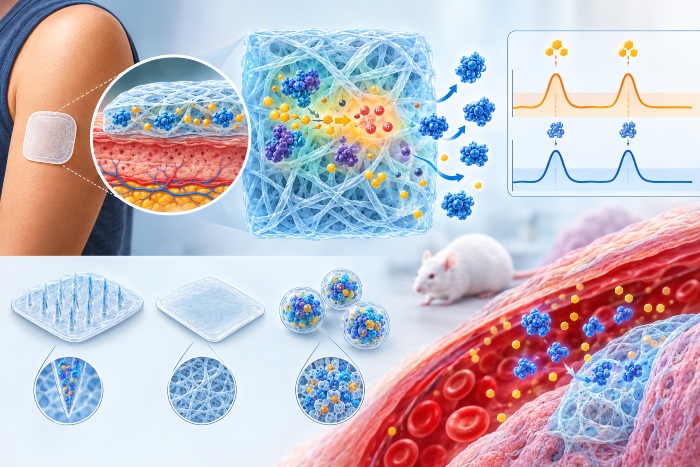
The most widely studied principle pairs glucose oxidase with the matrix. The oxidation of glucose produces gluconic acid, with a local drop in pH, and the resulting change in the matrix’s charge or structure alters the diffusion of insulin. In this context fibroin is interesting because its behavior depends on pH and secondary structure, with an isoelectric point around 4, and because it makes it possible to preserve the activity of the hormone in dry form, with stabilizing effects on conformation and shelf life that have been demonstrated for several sensitive biomolecules. One can build biodegradable microneedles, films and microparticles in which insulin and enzyme are co-encapsulated, with the matrix acting as a tunable diffusion barrier.
An alternative route employs phenylboronic acids, which reversibly bind the diols of glucose, with a consequent change in hydrophilicity and swelling. Coupling them with fibroin makes it possible to exploit the mechanical robustness of the matrix, but the affinity for glucose at physiological pH needs to be optimized.
The stability of insulin within the matrix is a point in its favor. The hormone tends to aggregate and form fibrils in aqueous solution under thermal and mechanical stress, and inclusion in a dry matrix can slow these processes, with the possibility of room-temperature storage for longer periods than liquid formulations. Verification with techniques such as circular dichroism, size-exclusion chromatography and biological activity assays is necessary to confirm that the released molecule is intact.
Evaluation criteria
The in vitro demonstration of on/off cycles between normoglycemia and hyperglycemia, with kinetics measured in minutes rather than hours, is the first threshold. Murine diabetic models follow, in which glycemic profiles, response to glucose tolerance tests and above all the absence of prolonged hypoglycemia are evaluated. The biocompatibility of the oxidase and of the by-products, in particular hydrogen peroxide, is an issue to be addressed, often by adding catalase.
The most studied geometries include microneedles that cross the stratum corneum and dissolve in the dermis, patches applied to the skin, and injectable microparticles. For chronic use, compatibility with repeated application and the absence of skin reactions are essential parameters, while the use of microneedles brings the advantage of painless and potentially self-managed administration, with a better acceptance profile than injections.
Open limits
What remains open are the duration of enzymatic activity in vivo, the dependence of the response on local oxygen, the delayed response relative to postprandial glycemic peaks, and reproducibility between individuals. It is a field in which the distance between proof of principle and an approvable device is still wide, but in which the possibility of a bioresorbable platform that can be stored without a cold chain would have a significant systemic impact.
Comparison with other platforms and perspectives
The field of smart insulin includes many competing technologies, from systems based on lectins such as concanavalin A to those using boronates, up to formulations with chemically modified insulin that binds glucose. Each has presented demonstrations in animals but none has reached approval, a sign of the difficulty of achieving reversibility, speed and safety together. Fibroin is proposed as a platform for retention and protection rather than as a recognition element, and its combination with proven mechanisms could offer an advantage in robustness.
The next steps call for studies in large-animal models with continuous glucose monitoring, repeatability tests over multiple cycles, and pharmacokinetic analyses demonstrating control of the release profile over a span of days. The demonstration of an improvement in time in range, with a reduction in hypoglycemic episodes, is the criterion by which a system of this kind would be judged in the clinic.
