
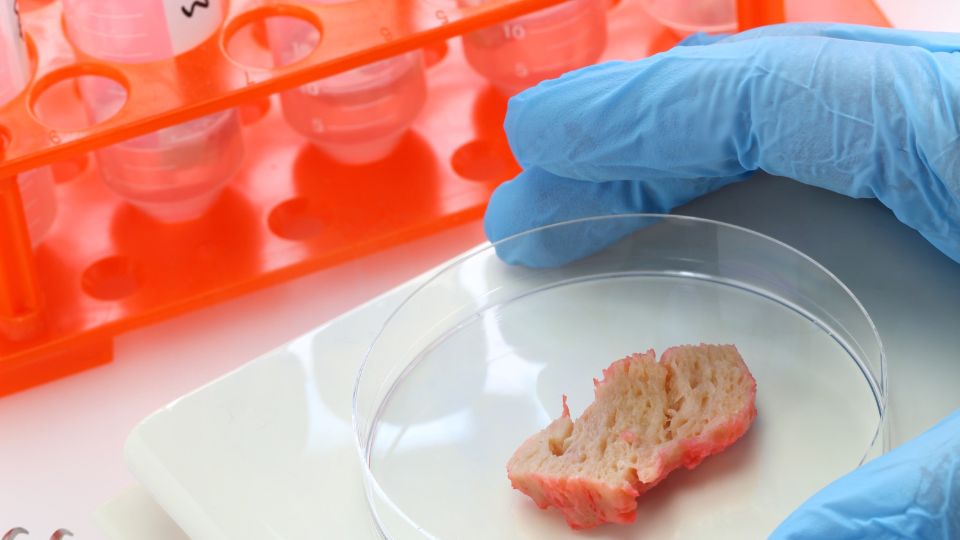
The production of cultivated meat requires three-dimensional systems capable of supporting the spatial organization of muscle and adipose cells, partially replicating the physical and biochemical characteristics of animal tissue. Scaffolds play a critical role in providing mechanical support, cell adhesion sites, and microenvironments for the diffusion of nutrients and oxygen. Experimental evidence shows that three-dimensional porous scaffolds significantly improve myogenic differentiation compared to two-dimensional cultures, leading to the formation of more mature and organized muscle structures.
Structural and functional properties for three-dimensional culture
Fibroin-based protein scaffolds have been studied for their ability to be processed into different architectures (electrospun nanofibers, porous sponges, hydrogels, and multilayer films). These structures can be designed with controlled porosity and fiber orientation, factors that directly influence muscle cell alignment and myotube formation. The tunability of mechanical properties makes it possible to achieve stiffness values similar to those of muscle tissue, a parameter known to influence cellular mechanotransduction and the regulation of myogenic gene expression.
These protein scaffolds effectively support the adhesion of muscle stem cells and myoblasts, promoting proliferation and differentiation. In in vitro models, fibrous scaffolds have been shown to promote cellular alignment along fibers, a prerequisite for the formation of functional muscle structures. Molecular analyses have highlighted the activation of myogenic markers such as MyoD, Myogenin, and MyHC, suggesting that scaffold topography and stiffness directly influence cell fate.
In vivo studies in animal models further demonstrate that protein scaffolds can support muscle regeneration and angiogenesis without inducing significant adverse immune responses, confirming the biocompatibility of the material and its potential applicability in complex biological systems.
Experimental applications in cultivated meat production
Recent studies on cultivated meat have used three-dimensional protein scaffolds to increase cell density and the formation of structured tissue. In three-dimensional cultures, these scaffolds enabled a significant increase in the available surface area for cell growth compared to two-dimensional supports, improving the volumetric yield of the tissue.
The presence of the scaffold modifies the gene expression profile of muscle cells, activating pathways related to differentiation, energy metabolism, and extracellular matrix formation. These results suggest that the scaffold is not a passive support, but an active element in controlling cell behavior.
The possibility of combining protein scaffolds with other natural and synthetic polymers allows the creation of composite materials with optimized mechanical and nutrient transport properties. In addition, composite scaffolds show greater cell infiltration and tissue contraction compared to single-component scaffolds, indicating that composition and microstructure influence muscle tissue maturation.
Compatibility with 3D bioprinting techniques and dynamic bioreactors has been demonstrated, highlighting the potential scalability of the material for industrial applications in cultivated meat production.
Biodegradability, safety, and implications for food use
Protein scaffolds exhibit controllable degradation and low cytotoxicity, characteristics that are essential for food applications. Degradation can be modulated through physico-chemical treatments, allowing the persistence of the scaffold during cell culture to be adapted.
In the context of cultivated meat, protein biomaterials are considered promising due to their intrinsic bioactivity, which can promote cell–matrix interactions without the need for complex biochemical additives. Moreover, biological scaffolds tend to improve cell adhesion and differentiation, while still presenting challenges in terms of standardization and large-scale production.
Available scientific evidence indicates that fibroin-based protein scaffolds are currently a promising platform for the three-dimensional cultivation of muscle tissues intended for cultivated meat. Excellent biocompatibility, support for cell proliferation and differentiation, and the ability to modulate cell behavior through controllable mechanical and topographical properties have been demonstrated.
The possibility of integrating such scaffolds with bioreactors, bioprinting techniques, and composite materials suggests a potential role in industrial-scale production.
