
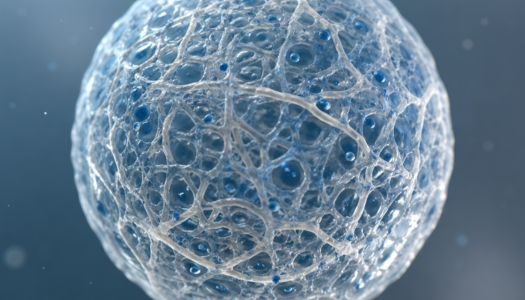
Nanogels are hydrophilic polymer networks of nanometric dimensions, typically between 20 and 500 nanometers, with an aqueous core that allows them to host both hydrophilic and hydrophobic molecules through physical interactions or reversible chemical bonds. Compared to other nanostructures — liposomes, solid polymeric nanoparticles, micelles — nanogels combine high loading capacity, elevated colloidal stability, and a degree of mechanical flexibility that facilitates interaction with cell membranes. The choice of fibroin as a material for constructing nanogels intended for intracellular delivery responds to very specific requirements. First, fibroin in aqueous solution can spontaneously form gel structures through conformational transitions from random coil to β-sheet, a process that can be controlled by pH, temperature, protein concentration, and ionic strength. This gelation can be exploited to entrap therapeutic molecules without resorting to organic solvents or high-energy processes that might degrade the active compounds. Second, the surface of fibroin nanogels is easily functionalizable with targeting ligands, different surface charges, and stealth agents such as polyethylene glycol (PEG), opening the way to highly selective delivery systems. Third, fibroin degradation occurs through the action of intracellular proteases — cathepsins and proteasomes — which means that drug release can be programmed to occur preferentially in the lysosomal or cytoplasmic environment of the target cell.
Mechanisms of cellular internalization
One of the most critical aspects in designing nanoparticle systems for intracellular use is understanding how nanoparticles cross the plasma membrane and reach the subcellular compartments of interest. Fibroin nanogels interact with cells through several endocytosis mechanisms, the prevalence of which depends on particle size, surface charge, and the ligands presented externally. For particles with a diameter below 200 nanometers and a slightly negative or neutral net surface charge, the predominant mechanism is macropinocytosis and the clathrin-mediated pathway. Particles are engulfed in endosomal vesicles, which progressively acidify their lumen as they transition from early endosomes (pH ~6.5) to late endosomes (pH ~5.5) and finally to lysosomes (pH ~4.5–5). If the therapeutic molecule to be delivered is sensitive to the lysosomal environment — as are many siRNAs, plasmids, or enzymatic inhibitors — endosomal escape strategies must be incorporated. In the case of fibroin nanogels, this can be achieved by embedding pH-responsive agents within the gel (polymers with amine groups that protonate in acidic environments, swelling and destabilizing the endosomal membrane), or by conjugating endosomal escape peptides directly onto the nanogel surface. For larger biologically active molecules, such as antibodies or enzymes, caveolin-mediated endocytosis offers an alternative pathway that partially bypasses the lysosomal route, reducing degradation of the cargo. The rational design of the nanogel surface — size, ligands, charge — makes it possible to selectively favor this pathway in specific cell types.
Drug loading strategies
Loading therapeutic molecules into fibroin nanogels can be achieved through two main approaches: physical loading during gel formation (entrapment) and chemical conjugation to the protein backbone. In physical loading, the therapeutic molecule is added to the fibroin solution before the gelation process begins. The interactions between the molecule and the protein matrix are non-covalent in nature: hydrophobic bonds, electrostatic interactions, hydrogen bonds. This approach is straightforward and preserves the integrity of the active molecule, but typically results in variable encapsulation efficiency and a release profile that may include an initial burst release — a fraction of the drug that diffuses rapidly outward in the first few hours. Studies conducted with doxorubicin — a widely used antitumor model compound — have shown that loading efficiency in fibroin nanogels can reach 70–85% under optimized conditions of pH and protein concentration, with an initial burst of 20–30% in the first four hours followed by sustained release over the subsequent 48–72 hours. Chemical conjugation, on the other hand, covalently links the therapeutic molecule to the functional groups exposed on the fibroin protein chain — primarily the primary amines of lysines, the carboxyl groups of aspartic and glutamic acids, and tyrosine residues. This strategy provides far more precise control over release, which occurs only when specific bonds are cleaved by intracellular enzymes or physicochemical stimuli such as glutathione reduction (abundant in the cytoplasm relative to the extracellular environment), UV/visible light, or pH shifts. Nanoparticle-based prodrugs built on this principle represent an active research frontier, particularly for oncological applications.
Applications in gene therapy and gene silencing
Among the most challenging therapeutic molecules to deliver to cells are nucleic acids: plasmid DNA, siRNA (small interfering RNA), microRNA, and, more recently, mRNA. These molecules are highly negatively charged, degraded by ubiquitous nucleases in biological fluids, incapable of independently crossing the cell membrane, and often subject to lysosomal degradation. Fibroin nanogels modified with positive surface charges — achievable through conjugation of polyamines or chitosan residues — form stable electrostatic complexes with nucleotide payloads, protecting them from nucleases and facilitating cellular internalization through interaction with the negatively charged plasma membrane. Studies published in journals such as Advanced Materials and Biomaterials have shown that cationic fibroin nanogels loaded with anti-VEGF siRNA are capable of reducing target gene expression by up to 80% in tumor cells in culture, with significantly lower cytotoxicity compared to classical commercial cationic liposomal vectors such as Lipofectamine. The antiangiogenic effect observed in murine models of colon cancer suggests that this platform could be translated toward in vivo applications, although the complexity of biological barriers in a living organism — immune system clearance, renal filtration, hepatic accumulation — requires further optimization.
Selective targeting and stimuli-responsive systems
Cellular specificity is an indispensable requirement for any drug delivery system intended for clinical use. Unfunctionalized nanogels distributed systemically tend to accumulate in the liver, spleen, and lungs due to reticuloendothelial clearance, drastically reducing the fraction that reaches the target tissue. Surface functionalization with targeting ligands overcomes this limitation by exploiting the overexpression of specific receptors on certain cell types.
In the oncological context, the most frequently exploited receptors include the folate receptor (overexpressed in ovarian, lung, and breast tumors), the HER2 receptor, the transferrin receptor (overexpressed in cells with high iron demand, such as tumor cells), and mannose receptors on immune system cells. Fibroin nanogels functionalized with folic acid have shown an uptake capacity in HeLa cells (folate receptor-positive) three to four times higher than in MCF7 cells (negative), confirming targeting selectivity in competitive endocytosis experiments with an excess of free folate. Even more sophisticated are stimuli-responsive systems, which release the drug only in response to specific signals from the tumor microenvironment or intracellular setting. Fibroin nanogels containing disulfide bridges within their network are rapidly destabilized in the presence of glutathione (GSH), which in the intracellular environment reaches concentrations 100 to 1,000 times higher than in the extracellular space. This concentration differential acts as a molecular switch that triggers drug release exclusively within living cells, reducing extracellular loss of the active compound. Similarly, sensitivity to the pH of the tumor microenvironment — typically more acidic than normal tissues — can be exploited by engineering the fibroin matrix with pH-dependent chemical groups.
