
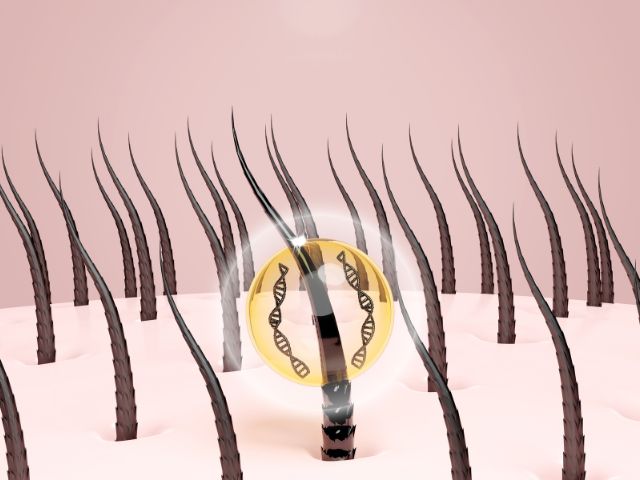
The bottleneck of follicular induction
Regenerating a functional follicle requires a reciprocal dialogue between dermal papilla cells and epithelial cells, mediated by Wnt, BMP, FGF and Shh signals. In monolayer culture, however, dermal papilla cells rapidly lose their trichogenic capacity, with reduced expression of markers such as versican, alkaline phosphatase and proteins of the Wnt pathway. As a result, the cell expansion that therapy requires, through autologous transplantation of cultured cells, cannot be used unless a way is found to restore inductivity. Three-dimensional culture techniques, whether in spheroids or on matrices, have been shown to recover this phenotype at least in part.
The clinical picture of alopecia includes forms with distinct mechanisms. In androgenetic alopecia, the progressive miniaturization of the follicle is mediated by dihydrotestosterone and by receptor sensitivity; in scarring forms, follicles are destroyed by an inflammatory process and replaced by fibrosis; and in alopecia areata, an autoimmune attack targets the bulb. A regenerative strategy is more plausible in scarring and post-traumatic forms, where the follicle is absent, than in androgenetic alopecia, where the structure exists but its cycle is altered.
The matrix as a regulator of phenotype
Fibroin scaffolds, in the form of hydrogels, microspheres, sponges or fibers, make it possible to control stiffness, porosity and ligand presentation, parameters that influence cell compaction and activation of the Wnt/beta-catenin pathway. Aggregation into three-dimensional architectures restores the expression of inductive genes and can improve the formation of follicular structures in mouse reconstitution assays using neonatal epithelial cells. Fibroin also offers a degradation kinetics slow enough to accompany the organization phase, together with the possibility of incorporating factors such as VEGF to promote perfusion around the neofollicle.
One approach attracting interest is the implantation of two-compartment dermo-epidermal constructs, in which the mesenchymal compartment is a fibroin hydrogel loaded with inductive cells and the epithelial compartment is a layer of keratinocytes, oriented so as to favor invagination.
Cell density and aggregate size are parameters that influence trichogenicity. It is known that the capacity to induce follicles increases with the number of implanted papilla cells, and that spheroids of adequate size maintain the expression of inductive genes more stably. The use of fibroin microspheres or microwells can standardize aggregate formation and allow the reproducible production of inductive units, a necessary condition for any therapeutic application.
Measurements and controls required
A credible demonstration of neogenesis requires more than the observation of follicle-like structures. It calls for histological evidence of a hair shaft with specific keratins, a bulb, a sebaceous gland and an arrector pili muscle, verification of the anagen-catagen-telogen cycle, and proof that the cells involved derive from the construct and not from the host skin. Hair orientation and integration with the epidermis are further aesthetic and functional parameters.
The orientation and emergence angle of regenerated hair carry aesthetic weight, and depend on the architecture of the construct and on the way it is implanted. Field experience shows that newly formed follicles often emerge in random directions, whereas topographic guidance from the matrix can help orient them. A quantitative evaluation with dermoscopy and trichoscopy, compared against native skin, is useful for measuring hair density, diameter and distribution.
Applications and cautions
The clinical targets include androgenetic alopecia, scarring alopecias and hair loss following burns. For now the field is predominantly preclinical, and the transition to humans requires repeatability, scalability of cell production and long-term oncological safety, set against pharmacological therapies and autologous transplantation that are already well established.
Integration with epithelial cells and signaling factors
Induction requires effective contact between the mesenchymal and epithelial components, and the way the scaffold organizes the two compartments is decisive. Approaches described include co-culture in layered matrices, with the dermal papilla below and the keratinocytes above, or implantation in a regeneration chamber on a mouse skin wound, where the cells self-organize into follicles. Fibroin contributes a controlled presentation of factors such as Wnt3a, BMP and FGF, whose sustained release can extend the induction window beyond what a bolus can achieve.
To move toward the clinic, the limit posed by the origin of the cells must be overcome. Autologous cells are scarce and rapidly lose function, which is why alternative sources are being studied, such as induced pluripotent cells differentiated along a dermal lineage, whose use requires guarantees of non-tumorigenicity. In parallel, an intermediate solution consists of using constructs that stimulate residual follicles through paracrine signals, a less ambitious goal than neogenesis but more practicable in the short term.
