
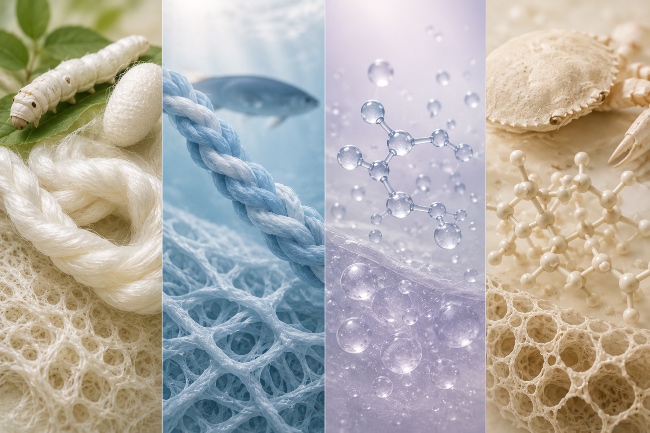
Anyone who works with fibroin often has to place it within a wider landscape, the one made up of the naturally derived biopolymers that populate the same catalogues, the same scientific papers and, at times, the same formulations. Collagen, hyaluronic acid and chitosan appear alongside the silk protein as if they were interchangeable variants of a single concept, yet in reality they are profoundly different molecules in terms of origin, chemical architecture, mechanical behaviour and logic of interaction with tissues. This comparative map takes fibroin as its known reference point and reconstructs, around it, the coordinates of the other three materials, so as to bring order to a family that is homogeneous only in appearance and to clarify when each biopolymer truly represents the most suitable choice.
Two great families: proteins and polysaccharides
The first distinction, the sharpest and the most useful, is chemical in nature. Fibroin and collagen are proteins, that is, chains of amino acids organised into secondary and tertiary structures that determine their form and function. Hyaluronic acid and chitosan belong instead to the world of polysaccharides, long chains built by repeating sugar units. This division is not a classificatory detail, because it conditions everything that follows: the way the material degrades, the enzymes that recognise it, the kind of biological signal it sends to cells and even its solubility.
Proteins carry with them a vocabulary of signals that cells can read directly, thanks to amino acid sequences recognised by membrane receptors. Polysaccharides, on the other hand, communicate in a more indirect way, through electrical charge, the capacity to bind water or the interaction with specific receptors such as those of hyaluronic acid. Keeping this dual membership in mind helps to avoid the most common mistake, that of expecting from the sugar what only the protein can offer, and vice versa. It is also the first element that sets fibroin apart from the two polysaccharides of the group: it speaks the language of proteins, whereas hyaluronic acid and chitosan belong to a different chemical register.
Collagen: the scaffold of the human body
Collagen is the most abundant protein in the mammalian organism and the principal constituent of the extracellular matrix of skin, bone, tendons and cartilage. Its structural signature is the triple helix, three chains wound around one another according to the repeated sequence glycine–X–Y, where the X and Y positions are often occupied by proline and hydroxyproline. Numerous types of collagen exist, but it is above all type I, present in skin and bone, and type II, typical of cartilage, that concern biomedical applications.
The great advantage of collagen is that cells recognise it as their own home. It contains sequences that bind to integrins and promote cell adhesion, migration and proliferation in an almost native way, a level of intrinsic bioactivity that fibroin, however excellent on the structural plane, does not possess in its natural state. This merit, however, has a downside. Since it generally comes from animal sources, whether bovine, porcine or marine, collagen carries with it a certain batch-to-batch variability, the risk of immune reactions and the concerns linked to the transmission of pathogens, which is why alternative sources such as marine and recombinant collagen have spread. On the mechanical side, moreover, pure collagen is relatively weak and degrades rapidly through the action of collagenases, in addition to showing limited thermal stability. It is an excellent material for dialoguing with cells, far less suited when significant loads must be borne on its own, and it is precisely on this terrain that the comparison with fibroin proves most illuminating.
Hyaluronic acid: the water held within the matrix
With hyaluronic acid we enter the territory of polysaccharides. It is a linear, non-sulfated glycosaminoglycan, built by alternating D-glucuronic acid and N-acetyl-D-glucosamine in chains that can reach very high molecular weights. Its defining property is a thirst for water: each molecule retains enormous quantities of liquid, conferring on tissues volume, hydration and that viscoelasticity which makes synovial fluid such an effective lubricant. It is no coincidence that hyaluronic acid is naturally present in the skin, in the joints and in the vitreous humour of the eye.
What often escapes notice is that hyaluronic acid is not merely a passive filler but also a signalling molecule. It interacts with receptors such as CD44 and RHAMM, and the kind of message it sends depends on molecular weight: long chains tend to exert an anti-inflammatory effect, whereas short fragments can stimulate inflammation and angiogenesis. It is moreover identical across all species, which makes it substantially non-immunogenic, a notable advantage over collagen. Its main limitation is temporal fragility, because it is degraded very quickly by hyaluronidases. For this reason, in applications that require persistence, such as dermal fillers or joint viscosupplementation, hyaluronic acid is chemically crosslinked, so as to slow its disappearance and stabilise its structure. This is exactly the opposite of fibroin, which owes its tunable durability to internal structure rather than to an external chemical intervention.
Chitosan: the cationic polysaccharide
Chitosan is obtained through the deacetylation of chitin, the polysaccharide that makes up the exoskeleton of crustaceans and the cell wall of many fungi. Its uniqueness within this quartet lies in charge. In an acidic environment chitosan becomes protonated and turns cationic, a rarity in the landscape of natural polymers, almost all of which are neutral or anionic. This surface positivity allows it to interact with bacterial cell membranes and with mucosal surfaces, and lies at the origin of two of its most appreciated properties, antimicrobial activity and mucoadhesiveness.
Chitosan is biodegradable, chiefly through the action of lysozyme, and is endowed with haemostatic capacities that have favoured its use in wound dressings and in agents for the control of bleeding. The degree of deacetylation, that is, the proportion of units that have lost the acetyl group, works like a dial that regulates solubility, charge, rate of degradation and biological properties. Its Achilles' heel is precisely solubility: chitosan dissolves well only in acidic solutions, which complicates certain formulations and conditions its use, although research has developed numerous derivatives to overcome this obstacle. It remains a valuable material wherever antibacterial action, adhesion to moist tissues and an easily functionalisable chemistry are required, all qualities that make it a natural complement, rather than a competitor, of structural materials such as fibroin.
Structure and mechanical properties compared
Placing the four materials on the same plane, the mechanical hierarchy emerges clearly. Fibroin occupies the summit for strength and capacity to withstand stress, and it is the only one in the group that can aspire, on its own, to demanding structural roles such as the regeneration of ligaments or bone tissue. Collagen, despite being the natural scaffold of tissues, turns out to be paradoxically weak when isolated, so much so that it almost always requires crosslinking or combination with other materials in order to acquire consistency. Hyaluronic acid, in its native form, has practically no mechanical properties worth mentioning and owes its usefulness to the capacity to retain water rather than to a load-bearing structure. Chitosan sits in an intermediate position, able to form films and hydrogels with reasonable properties, tunable through the degree of deacetylation and any crosslinking.
This difference translates into a recurring practical rule. When the objective is structural integrity, fibroin is the natural candidate. When instead the added value lies in the biological signal or in hydration, the other three find their space, often precisely in combination with a more robust support which, not infrequently, is fibroin-based.
Charge, bioactivity and cellular interaction
On the level of interaction with cells, each material tells a different story. Collagen speaks the native language of cell adhesion, offering recognition sites that cells use as anchoring points. Fibroin does not possess the same richness of intrinsic signals, but it is easily functionalisable and can be enriched with bioactive sequences or blended with other components to gain in adhesiveness, while keeping its mechanical advantage intact. Hyaluronic acid acts above all through its specific receptors and through the hydrated environment it creates, while chitosan leverages its own positive charge, which determines both its antimicrobial activity and its capacity to adhere to mucosae.
Electrical charge, in particular, sharply distinguishes the two polysaccharides. Hyaluronic acid is anionic, chitosan is cationic, and this opposite polarity makes them ideal candidates for assemblies based on electrostatic interactions, in which the two molecules attract one another and form complexes or multilayer films. It is an example of how different materials, instead of competing, can complement one another.
Degradation and biocompatibility
All four biopolymers share a fundamental merit, that of being biodegradable through physiological enzymatic pathways, which distinguishes them from synthetic polymers and makes them suited to uses in which the material must dissolve, leaving room for regenerated tissue. What changes, however, are the timescales and the controllability. Fibroin offers the finest modulation, because its rate of degradation can be programmed at the production stage by acting on internal structure. Hyaluronic acid, at the opposite end, disappears very rapidly if it is not crosslinked, and crosslinking therefore becomes almost obligatory for lasting applications. Collagen too degrades rather quickly, while chitosan shows an intermediate kinetics governed by the degree of deacetylation.
On the front of biocompatibility and immunogenicity, hyaluronic acid enjoys the most favourable profile, being identical across all species and therefore virtually non-immunogenic. Fibroin, when suitably purified, shows a contained inflammatory response. Chitosan is generally well tolerated. Collagen, owing to its animal origin, is the one that requires the greatest caution, which is why marine and recombinant sources conceived precisely to reduce risks have gained ground.
Processability and available formats
A criterion that is often decisive in practical choice is the variety of forms into which a material can be transformed. From this standpoint fibroin proves particularly versatile, lending itself to becoming films, hydrogels, sponges, microspheres, electrospun membranes and coatings, with a range of formats that makes it adaptable to very different contexts. Chitosan shares a good part of this versatility, being able to generate films, hydrogels, nanoparticles and dressings. Hyaluronic acid lends itself above all to hydrogels and viscous fluid formulations, consistent with its hydrophilic nature, while collagen finds typical expression in sponges, matrices and gels, as well as in the form of a bioactive coating to improve the cell adhesion of other supports.
Processability is never a purely technical datum, because it determines in concrete terms which applications are realistically accessible. A mechanically excellent material that is difficult to shape is worth little in an industrial context, and conversely ease of transformation can compensate for some intrinsic limitation.
When differences become complementarity
The most mature way of reading this map is not as a contest between competitors but as a repertoire of combinable functions. In research and development practice, these biopolymers are increasingly often blended precisely in order to sum their respective strengths. A fibroin support can be enriched with collagen to increase its bioactivity, exploiting the robustness of the one and the capacity for cellular dialogue of the other. Anionic hyaluronic acid and cationic chitosan can assemble into complexes that unite hydration and antimicrobial action. Collagen can be associated with hyaluronic acid to recreate an environment more similar to the native extracellular matrix, rich in both components.
From this perspective, comparative knowledge does not serve to crown a winner but to compose recipes. Knowing that fibroin brings structure, that collagen brings cellular recognition, that hyaluronic acid brings water and signal, that chitosan brings positive charge and antibacterial activity, means having at one's disposal four ingredients with clear and predictable properties, to be dosed according to the objective.
A choice guided by purpose, not by fashion
The lesson this map returns is as simple as it is often overlooked. There is no best biopolymer in absolute terms; there is the material most suited to a defined task. If the requirement is mechanical, fibroin starts with an advantage. If maximum affinity with cells is needed, collagen remains a reference. If the value lies in hydration and viscoelasticity, hyaluronic acid is irreplaceable. If antimicrobial action, mucoadhesion or an easily functionalisable chemistry are called for, chitosan offers solutions difficult to find elsewhere.
Behind the apparent interchangeability that catalogues suggest, then, lies a precise biological and chemical rationale. Recognising the differences between proteins and polysaccharides, between structural materials and signalling materials, between opposite charges and distinct degradation kinetics, is what separates a conscious use from an approximate one. And for those already familiar with fibroin, this map does nothing more than sharpen the contours of what surrounds it, turning a set of recurring names into a framework of reasoned choices.
