
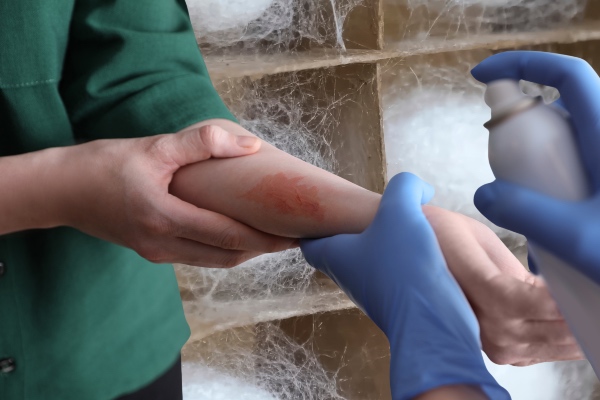
A third-degree burn, by definition, destroys the entire thickness of the epidermis and dermis, often reaching down into the subcutaneous tissue, and leaves behind a surface with none of the autonomous regenerative capacity that characterizes more superficial injuries. When this destruction extends across large portions of total body surface area, the picture stops being a purely dermatological problem and becomes a systemic challenge: loss of the cutaneous barrier exposes the patient to massive fluid and electrolyte dispersion, to severe thermoregulatory instability, and, above all, to an infection risk that remains the leading cause of death in major burn patients, with estimates attributing the majority of post-burn deaths to septic complications. In this context the dressing is never a peripheral gesture accompanying surgery, but a therapeutic device in its own right, called upon to temporarily fill the barrier functions the skin has lost, while awaiting escharectomy and autologous grafting, where feasible, to restore definitive coverage.
It is precisely the extent of the injury that complicates every strategy. In patients with limited burns, full- or partial-thickness skin grafting resolves the problem within a relatively contained timeframe; when the affected surface exceeds 20-30% of total body surface area, however, donor site availability drops sharply, and the temporary dressing or dermal substitute must support the wound bed for prolonged periods, often through repeated cycles of expanding the available donor sites. It is in this scenario, dominated by the scarcity of autologous tissue and the urgency of reducing fluid loss and bacterial load, that silk-derived biomolecules, sericin in particular, have begun carving out an increasingly solid space in research.
Sericin as a functional biomolecule, not a byproduct
For decades sericin was treated by the silk industry as waste to be eliminated during degumming, the sticky protein coating that wraps around fibroin fibers and that was dissolved and washed away to obtain the glossy yarn destined for weaving. This industrial history left behind a conceptual legacy that has proven hard to dislodge, that of a protein with no intrinsic biological value, one that only the biomedical research of the last two decades has progressively dismantled. Sericin is in fact a hydrophilic glycoprotein rich in serine residues and polar groups, with a water-retention capacity markedly higher than that of fibroin, and with a bioactivity profile that includes antioxidant properties linked to its capacity to neutralize free radicals, a modulating action on fibroblast proliferation and migration, and an effect favoring cell adhesion that makes it a natural candidate for coating matrices intended for tissue regeneration.
On the applied side, this combination of hydration, bioactivity, and biocompatibility has made sericin an increasingly common ingredient in wound care formulations, typically paired with fibroin, with polysaccharides such as chitosan or hyaluronic acid, or incorporated into topical creams and foams. The most recent direction in research, however, has shifted from the simple use of sericin as a functional additive toward its structural integration into three-dimensional scaffolds, freeze-dried sponges, and injectable hydrogels designed specifically for treating full-thickness tissue loss, the kind closest to the clinical picture of a third-degree burn.
Mechanisms of action on tissue healing
In vitro studies conducted on murine fibroblast cultures have shown that sericin, at concentrations on the order of one hundred micrograms per milliliter, is able to promote cell migration in scratch-closure assays with an efficacy comparable to that of epidermal growth factor used as a positive control, a finding that places the molecule among the few natural components capable of rivaling, at least in vitro, recombinant growth factors. This proliferative effect is accompanied by a modulating action on local inflammation, mediated in part by sericin's ability to act on signaling pathways involved in cell proliferation and extracellular matrix synthesis, including cascades such as TGF-β, historically central to the regulation of fibrogenesis and therefore to the final quality of scarring.
From a strictly physical standpoint, sericin's ability to form hydrophilic films and retain water helps maintain a moist microenvironment on the wound bed, a condition recognized as favorable to re-epithelialization since the classic studies on healing in an occlusive environment, and at the same time reduces the dressing's adherence to granulation tissue, a far from secondary point when one considers the mechanical trauma and pain associated with repeated dressing changes over large burned surfaces.
From evidence on second-degree burns to the challenges of third-degree burns
At this point it is necessary to introduce a distinction that the scientific literature draws fairly sharply and that a rigorous article cannot sidestep. The strongest body of clinical evidence on sericin in burns concerns predominantly second-degree lesions, not third-degree ones. A randomized clinical trial conducted on twenty-nine patients with sixty-five burn wounds, each covering no less than fifteen percent of body surface area, compared a standard silver sulfadiazine cream with the same formulation enriched with sericin, documenting improved healing parameters in the group treated with the added protein. This is a clinically relevant result, because it confirms over extended surfaces what the in vitro models suggested, but the histological picture of the burns enrolled in that study was one of partial-thickness lesions, meaning they retained residual dermis and skin appendages capable of sustaining assisted spontaneous re-epithelialization.
Third-degree burns pose a different problem, because the total absence of viable dermis eliminates the cellular source from which re-epithelialization could autonomously begin, and no dressing, however bioactive, can substitute for the need for a cellular supply or for definitive coverage, whether surgical or bioengineered. Sericin's role in this context therefore shifts from a direct healing agent to a functional component within more complex systems, designed to support the phase preceding grafting, to protect the wound bed while awaiting delayed surgery, or to be incorporated into temporary or permanent dermal substitutes intended to favor the subsequent take of the graft.
Composite scaffolds and dermal substitutes
This is where the most recent research on silk-derived biomaterials shows the most promising developments for large full-thickness surfaces. Fibroin-based scaffolds, often combined with sericin, hyaluronic acid, or fibrin, are now being designed to replicate the porous architecture of the native extracellular matrix, offering hydrophilic surfaces that favor the adhesion and proliferation of fibroblasts and, in some experimental models, of the endothelial cells needed to initiate neoangiogenesis, a critical step for the integration of any skin substitute of significant thickness. Studies conducted on murine models of critical-size full-thickness burns have documented that composite fibroin-based matrices, integrated with hemostatic components and hyaluronic acid, are able to simultaneously favor immediate bleeding control, self-adhesion to the wound bed without the need for sutures, and faster progression of granulation compared with untreated controls.
In parallel, injectable fibroin-based hydrogels are being developed with the ability to conform to irregular wound beds, a feature of particular interest in extensive burns, where the surface to be covered rarely presents a regular geometry and where the dressing's adaptability to the lesion's morphology directly affects its protective efficacy. In this scenario sericin acts predominantly as a hydrating and bioactive component within a broader system, rather than as an isolated active ingredient, and its integration into composite matrices appears, at the current state of research, to represent the most concrete path toward real use in full-thickness burns over large surfaces.
Practical management of large surfaces: infection, fluid loss, pain
Beyond the biological mechanism, any dressing intended for a major burn patient must meet three practical needs that condition survival even before the aesthetic quality of the final result. The first is control of bacterial load, given that the bed of a full-thickness burn, lacking an epithelial barrier, represents an ideal culture medium for opportunistic pathogens; sericin-based formulations are often paired with antimicrobial agents, as in the case of the silver sulfadiazine already mentioned, precisely because the protein alone does not possess sufficient antibacterial action to be used by itself on an extensive, high-infection-risk surface. The second need is containing fluid and electrolyte loss, a problem that in patients with burns exceeding twenty percent of body surface area becomes comparable, in clinical relevance, to overall hemodynamic management, and one that sericin's water-retention capacity, combined with the occlusive properties of the matrices it is incorporated into, helps mitigate. The third is management of pain and iatrogenic trauma linked to dressing changes, an aspect that the non-adherent properties of sericin-based films and hydrogels address by reducing the need for traumatic detachment from newly formed granulation tissu
